ENCOMPASS, LLC
Contextual Factors to Consider Before Choosing Public-Private Partnerships
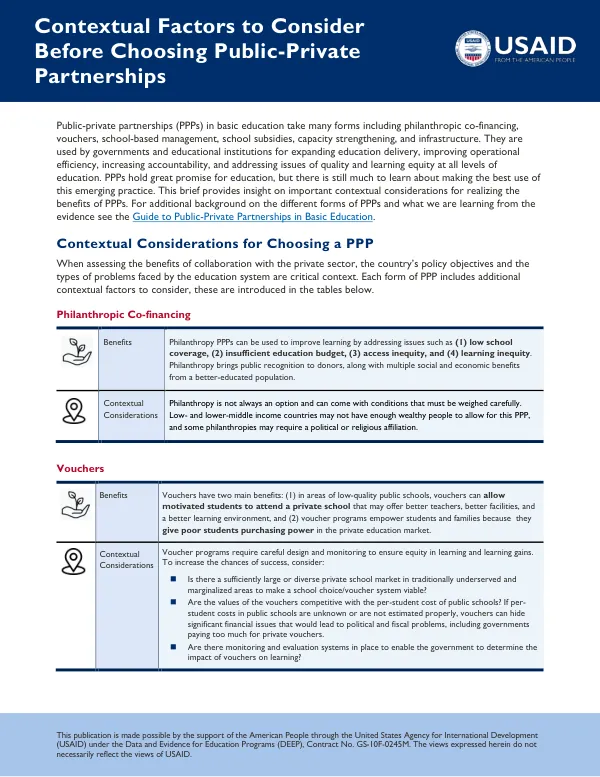
Public-private partnerships (PPPs) in basic education have become increasingly popular as governments and educational institutions seek to expand education delivery, improve operational efficiency, and address issues of quality and learning equity.
2023 · 3 pages
Sign in to readA free account is required to download.
Abstract
PPPs take many forms, including philanthropic co-financing, vouchers, school-based management, school subsidies, capacity strengthening, and infrastructure development. Philanthropic co-financing involves partnerships between governments and private donors to improve learning outcomes. This type of PPP can address issues such as low school coverage, insufficient education budget, access inequity, and learning inequity. However, philanthropy is not always an option, and it can come with conditions that must be weighed carefully. Low- and lower-middle income countries may not have enough wealthy individuals to allow for this type of PPP, and some philanthropies may require a political or religious affiliation. Vouchers are another form of PPP that can provide students with purchasing power in the private education market. Voucher programs can empower students and families by giving them the ability to choose a private school that may offer better teachers, facilities, and learning environment. However, voucher programs require careful design and monitoring to ensure equity in learning and learning gains. It is essential to consider whether there is a sufficiently large or diverse private school market in traditionally underserved and marginalized areas, whether the values of the vouchers are competitive with the per-student cost of public schools, and whether there are monitoring and evaluation systems in place to determine the impact of vouchers on learning. School-based management PPPs can help solve issues such as low quality of public schools, poor teacher performance, low student learning, and limited school choice. Private school management may be more efficient and effective than public management because private schools work under budget constraints, engage parents, and show good results in terms of educational output and learning. However, school-based management works well in countries with a healthy private school sector, which can offer a steady supply of capable school managers. School subsidies can help alleviate problems of school access, increase school choice for parents, and improve K-12 education and TVET training quality. Governments can provide subsidies to private schools, which may include schools owned by nonprofit associations and faith-based schools. However, school subsidies work well under a decentralized system that has experience with school-based management, and financial accountability can be a problem in countries with inadequate financial management systems. Capacity strengthening PPPs can help schools address issues such as low content knowledge among teachers, low pedagogical capacity, poor student management, and low technological knowledge among teachers and school managers. However, when looking at capacity strengthening, it is essential to consider whether the private sector is large enough to meet training demands in industry or services, whether the labor market can absorb a large influx of specialized workers, and whether private sector leaders are willing to collaborate with the government. Infrastructure PPPs can be very useful to resolve issues related to limited or no public financing availability, deficient infrastructure capacity, infrastructure in disrepair, or outdated educational facilities. However, infrastructure PPPs can be very complicated contractually, and many governments may not have the appropriately skilled personnel to undertake these partnerships. This complexity can lead to problems of corruption on a large scale. Monitoring is essential for the success of a PPP, as the results tend to be more modest than the theory suggests. PPPs that rely on contracts and vouchers are promising means for the private provision of public education, but the results are bound to be more modest than promised by the contract if a country is not equipped to monitor compliance and enforce accountability.
Related documents