ENCOMPASS, LLC
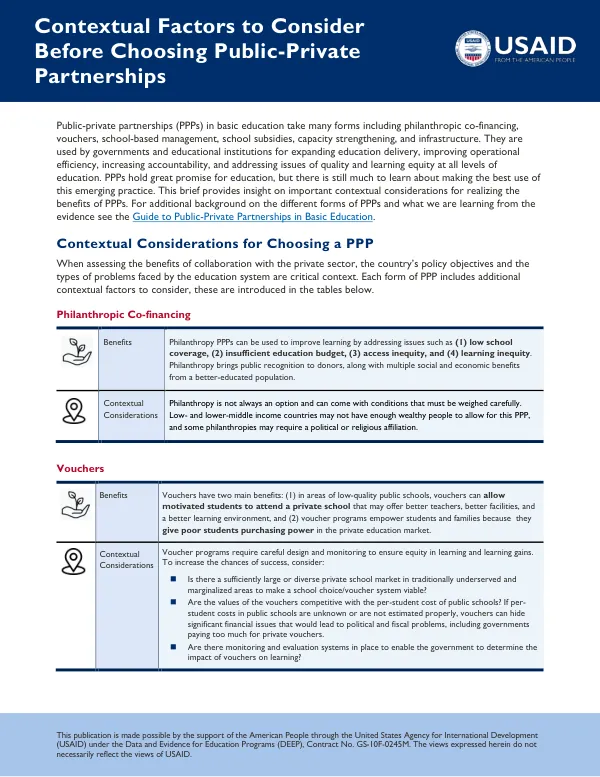
Guide to Public-Private Partnerships in Basic Education
Public-Private Partnerships in Basic Education have gradually grown in importance as policy tools over the past two decades.
2023 · 20 pages
Sign in to readA free account is required to download.
Abstract
Governments make increased efforts to circumvent problems in the delivery and quality of public education. Improvements in public education are often delayed by financial, legal, regulatory, bureaucratic, or institutional issues. A Public-Private Partnership may be more efficient and/or more effective in carrying out the responsibilities of government. Government funding for education may be insufficient to fulfill educational mandates. Insufficient funding may be due to low government revenues, inefficiencies in the use of public funds, rigidities and earmarks in the education budget, or higher than expected growth in enrollment. In all of these cases, Public-Private Partnerships can be a solution. A Public-Private Partnership makes sense when private providers are cost-effective, their infrastructure is already available, and they have room for increased enrollment. Structural problems in the education sector may result in inequitable access to education, or lower learning equity. Cultural biases against investing in marginal areas, education infrastructure that is insufficient to serve marginalized populations, or lack of human resources serving populations that speak minority languages are a few of the many situations where public education may fall short of its duties to be universal and equitable. These shortcomings in policy or coverage may be alleviated by Public-Private Partnerships that can expand school coverage in underserved areas or to marginalized populations more quickly than government. Parents want to have more choice. Parents may want to have a say in the type of school their children attend. In cases where there is a lack of schools, or parents are dissatisfied with public schools in their area, or would like their children to attend faith-based schools, Public-Private Partnerships can be effective. Private schools that accept children whose fees are paid with public funds, or charter schools with different educational methods are examples. Public education systems often do not have the capacity to develop and implement technological advances. Public school systems often lack the staff needed to carry out teacher training and capacity building in new pedagogical approaches. In these cases, private providers may help public schools in developing new learning platforms, new digital technologies, and new approaches to hybrid models of education delivery. Hence, Public-Private Partnerships can be crucial for co-financing development efforts, and for sharing the risks inherent to developing educational innovations. Improving the accessibility and quality of Technical and Vocational Education and Training (TVET) through a Public-Private Partnership can help resolve problems of low access to vocational and technical education in poor or hard-to-reach areas, empower TVET students by giving them the choice of training programs, and improve the quality and relevance of the training. Partnerships with the private sector in TVET can be very successful in preparing students for the labor market. A well-trained labor force is fundamental for increasing labor productivity and competitiveness, and Public-Private Partnerships in TVET can be right on target for implementing USAID policies that foster self-reliance. Private providers may be more efficient in delivering education services because they are used to competitive pressures, with implicit managerial and operational approaches that differ from those used in the public sector. Private providers have specialized skills that may not be available in the public sector, especially in the areas of information and communication technologies, and vocational and technical education. Private providers do not face the same restrictions as civil service employees—such as salary scales, work regulations, seniority, and pension plans.