INDONESIAN MINISTRY OF RESEARCH, TECHNOLOGY, AND HIGHER EDUCATION
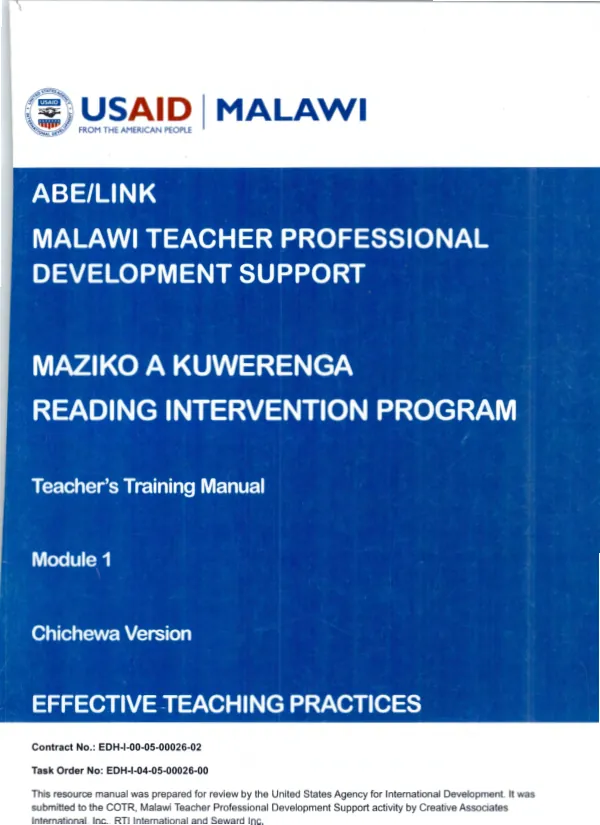
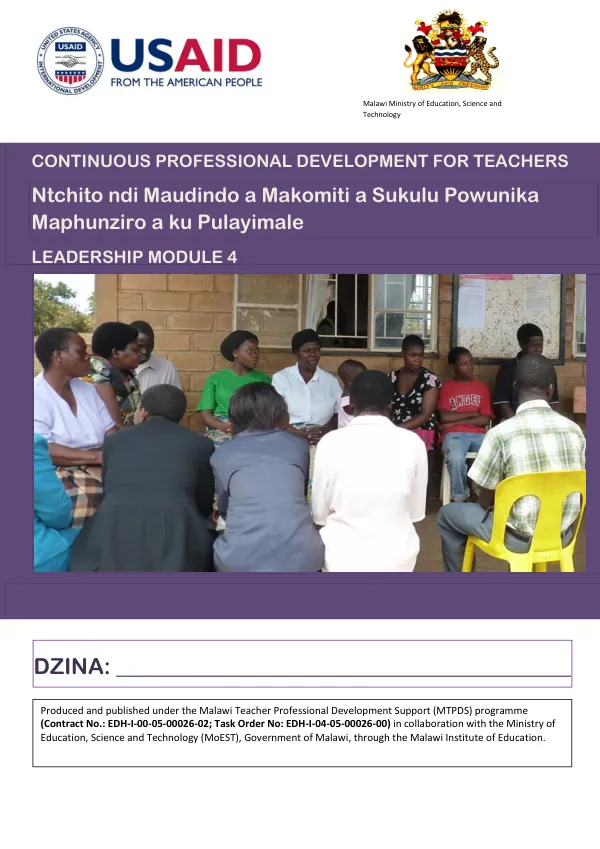
Continuous Professional Development for Teachers Leadership Module 4
The Malawi Ministry of Education, Science and Technology initiated the Continuous Professional Development for Teachers program, a leadership module aimed at enhancing the skills of school management committees, parent-teacher associations, and teachers.
2012 · 37 pages
Sign in to readA free account is required to download.
Abstract
The program is part of the Malawi Teacher Professional Development Support (MTPDS) program, funded by the USAID Malawi Teacher Professional Development Support program. The program's main objective is to improve the leadership skills of school management committees and parent-teacher associations, enabling them to effectively manage schools and make informed decisions. The module focuses on three key areas: leadership, school assessment, and community engagement. The program aims to equip teachers with the necessary skills to lead schools effectively, manage resources, and improve student outcomes. The module is designed to be implemented in schools across Malawi, with a focus on rural areas where access to education is limited. The program recognizes the importance of community involvement in education and seeks to engage parents, teachers, and local leaders in the decision-making process. The module is divided into two parts, with the first part focusing on leadership skills and the second part focusing on school assessment and community engagement. The program's approach is based on the principles of Continuous Professional Development (CPD), which emphasizes the importance of ongoing learning and professional growth for teachers. The module is designed to be flexible and adaptable to the needs of individual schools and communities. The program's success depends on the effective implementation of the module, which requires the active participation of teachers, school management committees, and parent-teacher associations. The module's content is based on the Malawi National Educational Sector Plan (NESP) and the Primary Curriculum and Assessment Reform (PCAR) initiative. The program seeks to improve the quality of education in Malawi by enhancing the leadership skills of teachers and school management committees. The module's outcomes are expected to improve student outcomes, increase teacher motivation, and enhance community engagement in education. The program's implementation is overseen by the Malawi Institute of Education, in collaboration with the Ministry of Education, Science and Technology, and the USAID Malawi Teacher Professional Development Support program. The program's success will be evaluated through regular assessments and feedback from teachers, school management committees, and parent-teacher associations. The module's content includes case studies, examples, and exercises designed to enhance the leadership skills of teachers and school management committees. The program's approach is based on the principles of adult learning, which emphasizes the importance of active participation, reflection, and application of learning. The module's outcomes are expected to improve the quality of education in Malawi, increase teacher motivation, and enhance community engagement in education. The program's impact will be measured through regular assessments and feedback from teachers, school management committees, and parent-teacher associations. The program's success will depend on the effective implementation of the module, which requires the active participation of teachers, school management committees, and parent-teacher associations. The program's outcomes are expected to improve student outcomes, increase teacher motivation, and enhance community engagement in education. The module's content is designed to be flexible and adaptable to the needs of individual schools and communities. The program's approach is based on the principles of Continuous Professional Development (CPD), which emphasizes the importance of ongoing learning and professional growth for teachers. The module's outcomes are expected to improve the quality of education in Malawi, increase teacher motivation, and enhance community engagement in education.