INDONESIAN MINISTRY OF RESEARCH, TECHNOLOGY, AND HIGHER EDUCATION
Early Grade Reading Activity
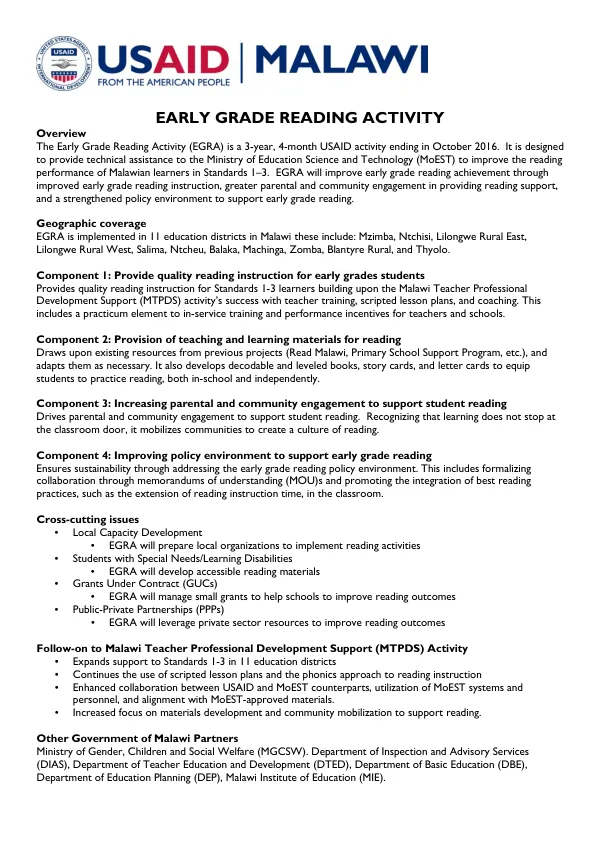
The Early Grade Reading Activity (EGRA) is a 3-year, 4-month USAID activity designed to improve the reading performance of Malawian learners in Standards 1-3.
2016 · 1 pages
Sign in to readA free account is required to download.
Abstract
The activity aims to enhance early grade reading achievement through improved instruction, greater parental and community engagement, and a strengthened policy environment. EGRA is implemented in 11 education districts in Malawi, including Mzimba, Ntchisi, Lilongwe Rural East, and others. Component 1 of EGRA focuses on providing quality reading instruction for early grade students. This involves building upon the success of the Malawi Teacher Professional Development Support (MTPDS) activity, which provided teacher training, scripted lesson plans, and coaching. The component includes a practicum element to in-service training and performance incentives for teachers and schools. The goal is to equip teachers with the skills and resources needed to deliver effective reading instruction. Component 2 of EGRA involves the provision of teaching and learning materials for reading. This includes adapting existing resources from previous projects, such as Read Malawi and the Primary School Support Program, and developing new materials such as decodable and leveled books, story cards, and letter cards. These materials are designed to equip students to practice reading both in-school and independently. Component 3 of EGRA aims to increase parental and community engagement to support student reading. This involves mobilizing communities to create a culture of reading and recognizing that learning does not stop at the classroom door. The component seeks to engage parents and communities in supporting student reading and promoting a love of reading. Component 4 of EGRA focuses on improving the policy environment to support early grade reading. This includes formalizing collaboration through memorandums of understanding (MOUs) and promoting the integration of best reading practices, such as extending reading instruction time, in the classroom. The goal is to ensure sustainability and address the early grade reading policy environment. Cross-cutting issues addressed by EGRA include local capacity development, students with special needs or learning disabilities, grants under contract, and public-private partnerships. The activity also builds on the success of the MTPDS activity, expanding support to Standards 1-3 in 11 education districts and continuing the use of scripted lesson plans and the phonics approach to reading instruction.