USAID DEC
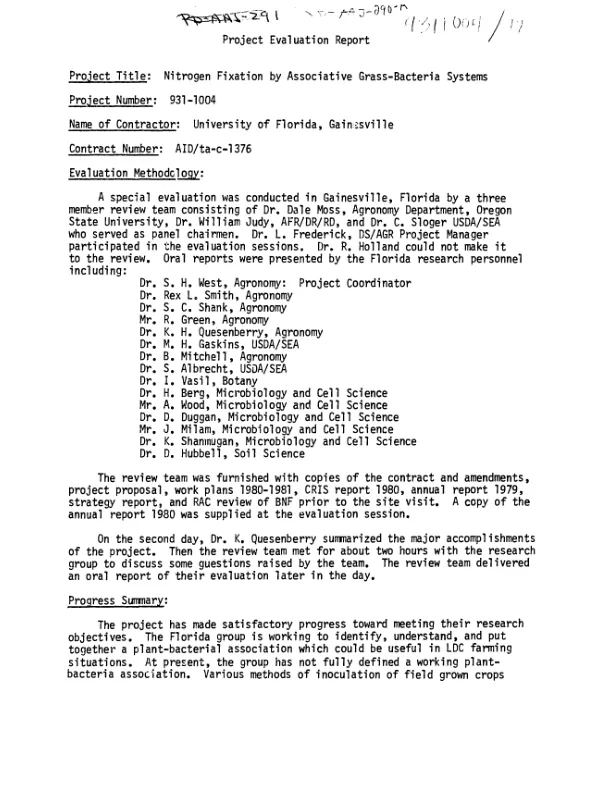
Nitrogen fixation by associative grass - bacteria systems; project evaluation report
Sign inUNIVERSITY OF FLORIDA
Nitrogen fixation by associative grass - bacteria systems; project evaluation report
Evaluates project to identify, isolate, and analyze nitrogen(N)-fixing plant-bacteria (P-B) systems for use in developing country agriculture.
Sloger, Charles · 1981
Sign in to readA free account is required to download.
Abstract
Evaluation covers the period 6/78-6/81 and is based on a review of the project by A.I.D. and contractor, the University of Florida (UF), personnel. The complex nature of the research slowed progress in identifying bacteria with consistent N-fixing responses and in developing methods to measure such responses. Nonetheless, use of a multi-disciplinary approach, effective project management, and added financial support from the UF and the U.S. Department of Agriculture enabled researchers to successfully collect and evaluate bacteria from all over Florida, to investigate the factors affecting N-fixation, to develop techniques for studying P-B systems, and to lay the groundwork for genetic modification of these bacteria. Regarding specific experiments, inoculation of grasses has increased yields significantly only half the time; tests have revealed time after planting, soil moisture, soil pH, N fertilization, and light intensity to be the primary variables. Attempts to measure biological N-fixation with 15N dilution experiments were inconclusive due to the location and low N status of the test soils and to inadequate controls. Studies with combinations of tissue culture and Azospirillum strains have indicated that a plant factor influences the N-fixing efficiency of Azospirillum. Also prepared were six journal papers, four Ph.D. dissertations, ten professional papers, and three book manuscripts. In addition, unanticipated requests for assistance by the Governments of Mali and Egypt have provided an opportunity to establish research contacts in developing countries. It is recommended that: (1) research activities be coordinated with international and LDC research efforts; (2) economic feasibility studies of P-B systems be deferred until a consistently active system is identified; (3) research on chemotaxis and axenic P-B combinations be de-emphasized; (4) continued emphasis be given to developing P-B systems suited to food crops; (5) in designing experiments, greater consideration be given to basic regulatory and genetic constraints of N-fixing bacteria; and (6) a soil scientist experienced in 15N isotope techniques be involved in 15N dilution field experiments.