U.S. DEPT. OF AGRICULTURE
CONTROL OF VERTEBRATE PESTS - RESEARCH REVIEW REPORT
Evaluates project to develop methods to control vertebrate pests that destroy crops in LDC's.
FITZWATER, WILLIAM D.|GRAY, ROBERT E.|LOVINGER, KING L. · 1979
Sign in to readA free account is required to download.
Abstract
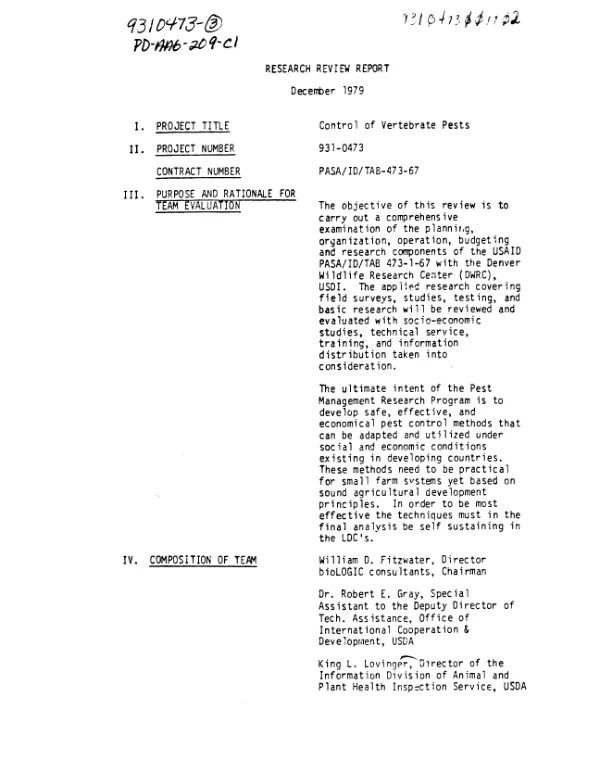
Evaluation covers the period 10/1/78-9/30/79, and was conducted by three livestock scientists from the U.S. government and the private sector. No methodology is indicated. As a result of this project, the Denver Wildlife Research Center (DWRC) published over 200 technical reports on the results of their research and distributed them to cooperating LDC's. Host country researchers co-authored many of these technical reports. DWRC also explored new methodologies for damage assessment, such as producing index surveys for rodent damage in transplanted rice and bird damage to corn. Predetermined goals achieved in the Philippines were improved anti-coagulant baiting methods for rice field rodent control, and pest control research and training which was incorporated into the National Crop Protection Center's Program. It was determined in the Sudan that currently ineffective bird control programs could be greatly improved by using methiocarb repellent head sprays. In Bangladesh, the Agricultural Research Institute formed a Vertebrate Pest Division; training sessions for government personnel were held; and a wheat rodent damage survey was completed. In Haiti, information was assembled on vertebrate pests and related agricultural problems. DWRC TDY activities were important in evaluations, training, liaison/coordination and cooperative studies with international research organizations. The need for DWRC personnel has decreased as target countries, like the Philippines, establish their own research and training to respond to the vertebrate-pest problems. It is recommended that USAID continue to assist DWRC field and laboratory research, evaluation, training, and information dissemination and to act as liaison between DWRC and field personnel. Specific needs resulting from this project are identified in the toxicological, chemical, pest, and environmental analyses of this paper. This report is attached to Project PES (PN-AAG-209-B1).