MERCY CORPS INTERNATIONAL
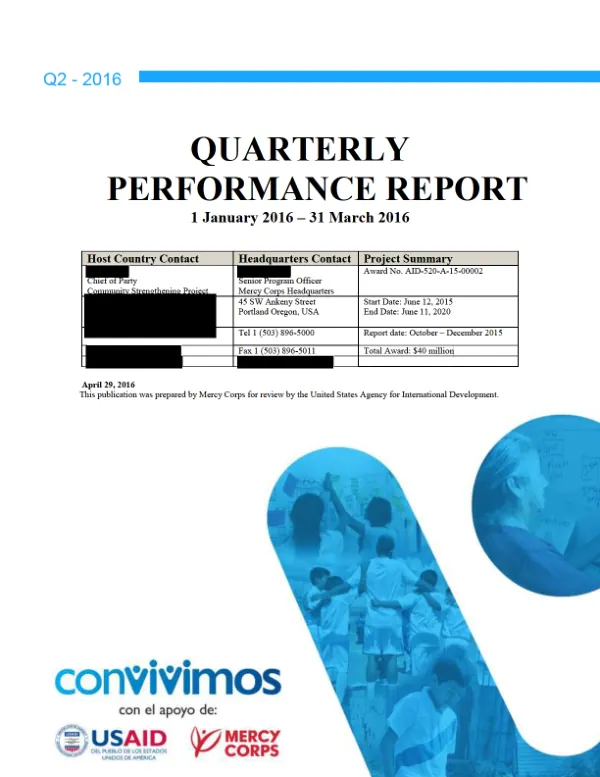
Convivimos Project: Progress Report January 1 to March 31, 2016
The Convivimos Project is a community-based initiative aimed at preventing violence in Guatemala's most affected municipalities.
2016 · 44 pages
Sign in to readA free account is required to download.
Abstract
The project focuses on municipalities with high homicide rates, including Guatemala, Mixco, Villa Nueva, and Amatitlán, and targets 80 communities with a population of over half a million people. The project uses a cluster approach, combining primary and secondary prevention services and expanding opportunities for participation in developmental activities. The project addresses both the underlying drivers of chronic violence and immediate trigger factors, such as alcohol/drug use, interpersonal conflicts, and other conditions. It promotes a multi-stakeholder, inter-institutional, municipal, and community-level prevention model focused on demand-driven holistic interventions. Secondary prevention approaches, which focus on expanding opportunities for at-risk youth, are also an essential component of the project. The Convivimos Project is based on the theory of change that strengthening capacities of the individual, family, community, and government will result in increased community resilience and safer, more secure communities. The project works in close coordination with national and municipal governments, engaging stakeholders such as prevention services providers, private sector foundations and companies, research and advocacy organizations, and those representing at-risk populations. During the reporting period from January 1 to March 31, 2016, efforts focused on consolidating relationships with community and municipal leaders, launching community commissions, initiating commission plans, evaluating community projects, and starting up the provision of prevention services. The project also began the school-based violence prevention program, formalized positive relations with new and returning municipal governments and stakeholders, and established the program Research Council. Establishing and strengthening community organizations is a cornerstone of the project's approach. This involves working with families and community organizations identified through institutional mapping to organize, connect, and mobilize to identify needs, challenges, and goals, and act collectively to achieve them. The project has organized the 52 communities into 265 sectors, elected representatives of sectors through community assemblies, and integrated Community Organizations for "Convivencia" as a democratic space of representative participation that articulates all existing community organizations and leaderships. Building strategic alliances is also a key aspect of the project's strategy. This involves influencing public policies and investments, expanding resources, and improving the quality and coverage of programs' activities. A Memorandum of Understanding was signed with the municipality of Mixco, and signatures of MOU with Guatemala and Amatitlán will be finalized in early April. Cooperation agreements have also been established with Central Government agencies, including the Ministries of Interior, Social Development, and Education.
Related documents