USAID DEC
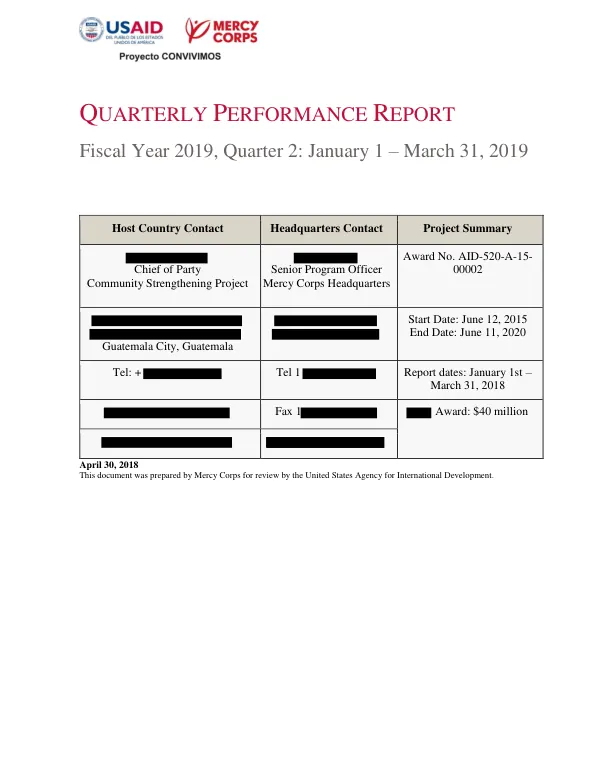
Quarterly Performance Report Fiscal Year 2019, Quarter 2: January 1 – March 31, 2019
Sign inMERCY CORPS INTERNATIONAL
Quarterly Performance Report Fiscal Year 2019, Quarter 2: January 1 – March 31, 2019
The Community Strengthening Project, known as the CONVIVIMOS Program, is a five-year violence prevention program funded by the United States Agency for International Development (USAID).
2019 · 47 pages
Sign in to readA free account is required to download.
Abstract
The program is based on the theory of change that if individual, family, community, and government capacities are improved, then communities' resilience will increase and communities will become safer and more secure. The project goal is to support the Government of Guatemala, municipalities, civil society, and community actors to address the causes and consequences of violence through integrated prevention techniques. The CONVIVIMOS program has four complementary and mutually reinforcing objectives. Objective 1 aims to support community commissions to institutionalize proven, integrated violence prevention projects in targeted areas. Objective 2 seeks to strengthen and mobilize municipal and national stakeholders and resources to develop and implement municipal-level violence prevention plans. Objective 3 focuses on supporting secondary prevention projects in close coordination with municipal authorities. Objective 4 promotes and integrates evidence-based policy making among violence prevention actors. During Fiscal Year 2019, Quarter 2, CONVIVIMOS partner FUNDAESPRO continued working with the Community Prevention and Coexistence Commissions (CCPCs) to update and operationalize the annual work plans derived from the Community Prevention and Coexistence Plans. Mercy Corps also supported the COCOPREs in San Miguel Petapa to develop their community violence prevention plans. The program reinforced the sustainability of community plans by working with the CCPCs to develop project proposals and identify potential funding sources. Key progress was made in mobilizing communities to prevent crime and violence. Community commissions were supported in developing violence prevention projects, and municipal authorities were strengthened to develop and implement violence prevention plans. The program also promoted evidence-based policy making among violence prevention actors. The CONVIVIMOS program has made significant progress in addressing the causes and consequences of violence in Guatemala. The program has worked with community commissions, municipal authorities, and civil society organizations to develop and implement violence prevention projects. The program has also promoted evidence-based policy making among violence prevention actors. The program's objectives are aligned with the Government of Guatemala's efforts to address violence and insecurity. The program's focus on community-based violence prevention and evidence-based policy making is critical to creating a safer and more secure urban Guatemala. The program's progress has been significant, and it is expected to continue making a positive impact in the coming years. The CONVIVIMOS program has also made progress in strengthening the capacity of community commissions and municipal authorities to address violence and insecurity. The program has provided training and technical assistance to community commissions and municipal authorities to develop and implement violence prevention projects. The program has also supported the development of community-based violence prevention plans and municipal-level violence prevention plans. The program's progress has been monitored and evaluated through a range of indicators, including the number of community commissions and municipal authorities supported, the number of violence prevention projects developed and implemented, and the level of community engagement and participation in violence prevention activities. The program's progress has been positive, and it is expected to continue making a positive impact in the coming years. The CONVIVIMOS program has also made progress in promoting evidence-based policy making among violence prevention actors. The program has worked with government agencies, civil society organizations, and community-based organizations to develop and implement evidence-based policies and programs to address violence and insecurity. The program has also supported the development of research and evaluation capacity among violence prevention actors to inform policy and program decisions. The program's progress has been significant, and it is expected to continue making a positive impact in the coming years. The program's focus on community-based violence prevention, evidence-based policy making, and capacity building is critical to creating a safer and more secure urban Guatemala.
Related documents