USAID DEC
Cooperative agreement between AID and Macal Agricultural Cooperative to develop an indigenous dairy industry
Sign inUSAID. MISSION TO BELIZE
Cooperative agreement between AID and Macal Agricultural Cooperative to develop an indigenous dairy industry
Project to help the Macal Agricultural Cooperative (MAC) in Belize become a profitable dairy cooperative.
1986
Sign in to readA free account is required to download.
Abstract
The project, which builds on the Belize Livestock Development Project (5050006), in which MAC was reactivated to operate and eventually own a dairy plant, will be in 2 phases. In Phase I, MAC will receive TA and training in management and member education; in Phase II, it will expand its operations, using P.L. 480 local currency generations. Phase I of the project will improve MAC management and increase member farmers" understanding of their stake in the cooperative as owners. The objective is to increase MAC membership from 34 to 60 members and to increase members" delivery of raw milk to the plant to 250 gallons a day (about 30% above the breakeven rate of 150 gallons per day). Phase I is expected to last no longer than 2 years. Once USAID/B determines that MAC is a viable business, Phase II, a P.L. 480, Section 416 Surplus Dairy Commodities import program, will be implemented. In this phase, the Commodity Credit Corporation (CCC) will supply MAC with 300 MT tons (150 MT a year for 2 years) of processed cheese appropriately packaged for the Belize market. MAC will sell the cheese to commercial distributors at the usual market price. Proceeds from the sale of the cheese will enable MAC become financially independent and develop new operations, such as a centralized bulk milk collection system, installation of a simple cheesemaking facility, and expansion into the agricultural supply business to supply the needs of member farmers. By the end of the project, the cooperative"s dairy plant will be operating at capacity (400 gallons of milk per day), its share capital will have increased to Bz$35,000, and its profit margin will have stabilized at 25%. MAC will receive 36 person-months of long-term TA from a resident advisor, 7 months of short-term TA, and 4 months of technical training for one or two plant employees. In addition, the Belize government will supply a full-time extension agent to the plant and the Peace Corps will provide an animal husbandry expert.
Related documents
Documents in this collection
 1992
1992USAID DEC
AID grant amendment no. 505-0008-G-OPG-1001-01 to Belize Enterprise for Sustained Technology to continue supporting cooperative and association strengthening activities by specifically assisting the Belize Papaya Growers" Association
Open record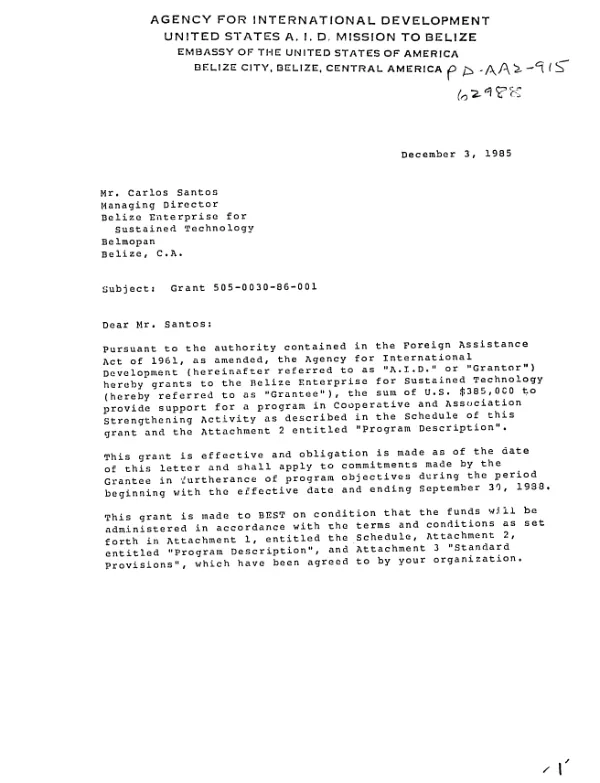 1985
1985USAID DEC