USAID DEC
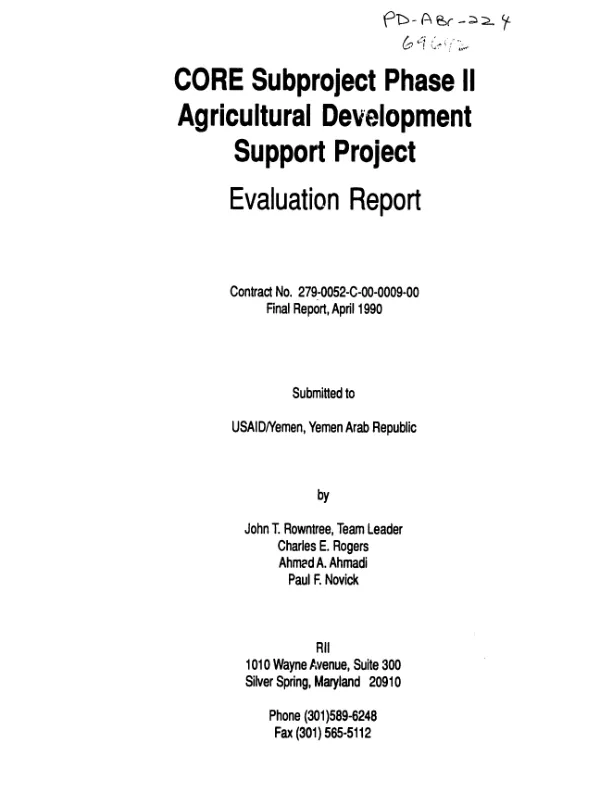
CORE subproject phase II, agricultural development support project : evaluation report
Sign inRICARDS INTERNATIONAL, INC.
CORE subproject phase II, agricultural development support project : evaluation report
Interim evaluation of Phase II of CORE subproject (SP) to strengthen the capacity of Yemen's Ministry of Agriculture and Fisheries (MAF) to plan and monitor a program supportive of private sector agriculture production and marketing.
Rowntree, John T.|Rogers, Charles · 1990
Sign in to readA free account is required to download.
Abstract
The evaluation covers the period 1985-4/90. CORE was redesigned after a 1984 evaluation of the overall project, but it took almost 3 years after the redesign to recontract the SP and obtain new SP management. Progress has been unsatisfactory. The MAF remains understaffed and in need of extensive training in technical agricultural economics, statistics, and management. Its internal planning processes are generally informal and unstructured, with little monitoring or accountability, and its budget is inadequate to maintain staff or supplies. The SP has purchased many expendable office supplies and furniture as well as equipment for which MAF may not be able to cover recurrent costs. SP focus has not been clear or consistent. Long-term TA has lacked continuity, and many advisors have played almost exclusively operational roles. Long- and short-term trainees have not been selected on the basis of MAF needs or budgets, and the development of a MAF training unit -- a major SP objective -- has not been pursued. Nonetheless, progress has improved during the past year, with a shift towards areas that are central to improving MAF capability to supporting private sector agricultural production and marketing. These areas include: planning and policy analysis, agricultural economics and marketing, and statistics and data collection. MAF has begun to be involved in designing annual work plans, and numerous monitoring and recordkeeping systems have been instituted. However, this progress is very recent, and much effort will be required to sustain it. The major lesson learned is that institution building requires the incorporation of several elements, including narrowly focused activities in a limited set of entities, a strong monitoring system, sensitivity to the socio-cultural-political environment, financial controls that limit spending on unsustainable activities, and selection of an experienced contractor with at least some bilingual capabilities.