ICF
Correlates of Secondary Infertility
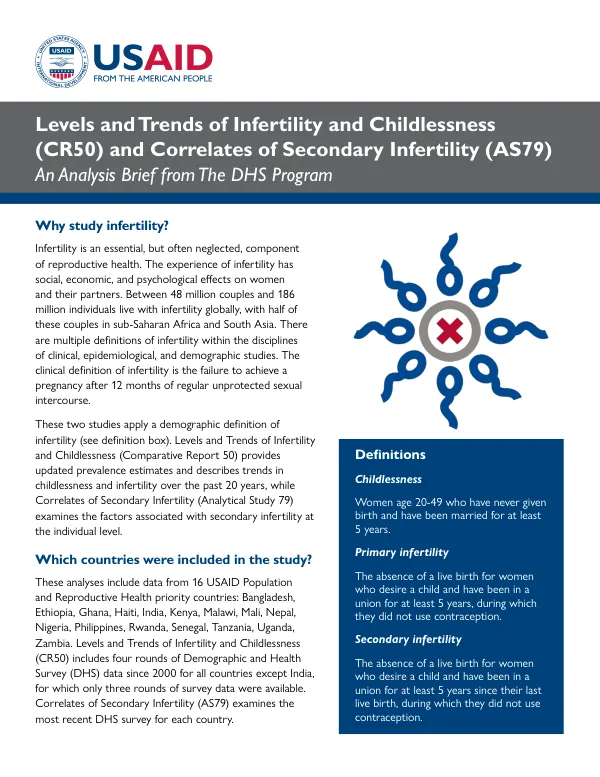
Secondary infertility refers to the inability to conceive a child after previously giving birth to one or more children.
2021 · 76 pages
Sign in to readA free account is required to download.

Abstract
This phenomenon affects a significant proportion of women worldwide, with varying prevalence rates across different countries and regions. Research has identified several sociodemographic variables associated with secondary infertility. Women's age, partner's age, and age at first cohabitation are found to be significant predictors of secondary infertility. Women who cohabited at a younger age are more likely to experience secondary infertility, whereas those who cohabited at an older age have a lower risk. Additionally, women who have other children under the age of 18 in the household are more likely to experience secondary infertility. Health-related variables also play a crucial role in secondary infertility. Women who have ever had a terminated pregnancy are more likely to experience secondary infertility. Furthermore, women's wealth quintile is also found to be associated with secondary infertility, with women from lower wealth quintiles having a higher risk. Regression analysis was conducted to examine the relationship between secondary infertility and various sociodemographic and health-related variables. The results indicate that women's age, partner's age, age at first cohabitation, number of children under 18 in the household, and wealth quintile are significant predictors of secondary infertility. A profile of women with secondary infertility reveals that they are more likely to be older, have a higher number of children, and have a lower wealth quintile compared to women without secondary infertility. These findings suggest that secondary infertility is a complex issue influenced by multiple factors, including sociodemographic and health-related variables. The study's results have implications for the development of policies and programs aimed at addressing secondary infertility. Understanding the correlates of secondary infertility can inform the design of interventions that target specific risk factors and populations. For example, programs that focus on improving access to family planning services, increasing awareness about reproductive health, and providing support for women experiencing secondary infertility may be effective in reducing the prevalence of this issue.