USAID DEC
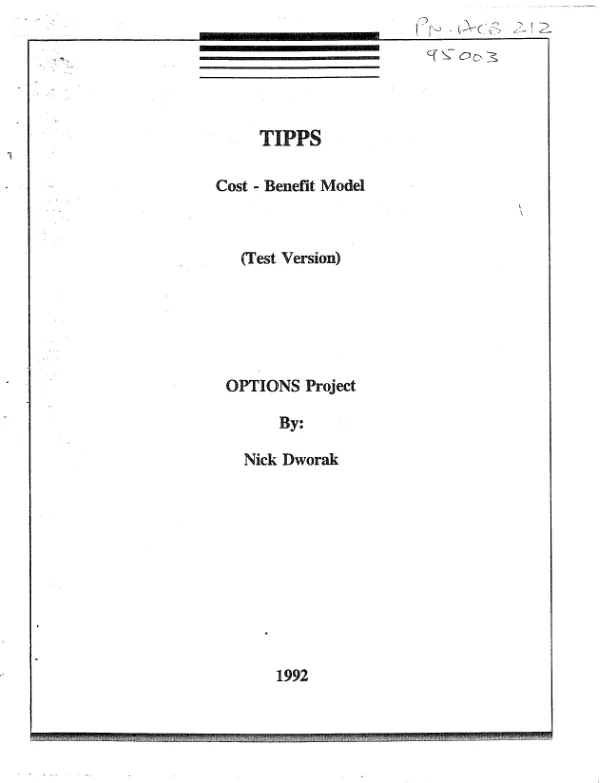
Cost - Benefit Model (Test Version)
The Cost-Benefit Model, a test version of the OPTIONS Project, is a software application designed to analyze demographic and economic data.
4 pages
Sign in to readA free account is required to download.
Abstract
The program consists of two separate and independent modules: the demographic module and the full model. The demographic module is stored in files with the extension CBM.*, while the full model is stored in files with the extension CBM1.*. The program does not require installation and can be run from any directory on a hard disk or floppy diskette. However, all program files must be located in the same directory, which must be the default directory when the program is called. Data files, on the other hand, can be located in a different directory. The program uses conventional memory only and expands in memory immediately after its kernel is loaded. It does not take any additional memory while in execution. The total memory size for the demographic module is 260K, and for the full model, it is 365K. The program does not employ any formal overlay construction and reads additional code program files immediately after loading. However, it does not check for validity a data file it reads from disk, which may cause a run-time error if the data file is altered by a user. The program operates in text video mode only and uses a nonstandard text font and light background colors without blinking. It requires a keyboard fully compatible with an IBM 101-key enhanced keyboard and may not support a floppy diskette with a format other than standard: 360K, 720K, 1.2M, or 1.44M. The program is designed to be used as a worksheet with predefined formulas rather than a menu-driven application. It attempts to compute results even if a user does not complete data entering or makes an error. If an output variable cannot be computed, its location on the output screen is left blank. Recalculation is done automatically, and the output screen always corresponds to the most recent alterations of the input worksheet. The program does not employ a numerical coprocessor and stores numbers with exactly the same precision as they are shown on the screen. The precision of computation is therefore low. Interpolation is done employing a quadratic parabola whose first derivative assumes zero at the initial or terminal point of interpolation.