USAID
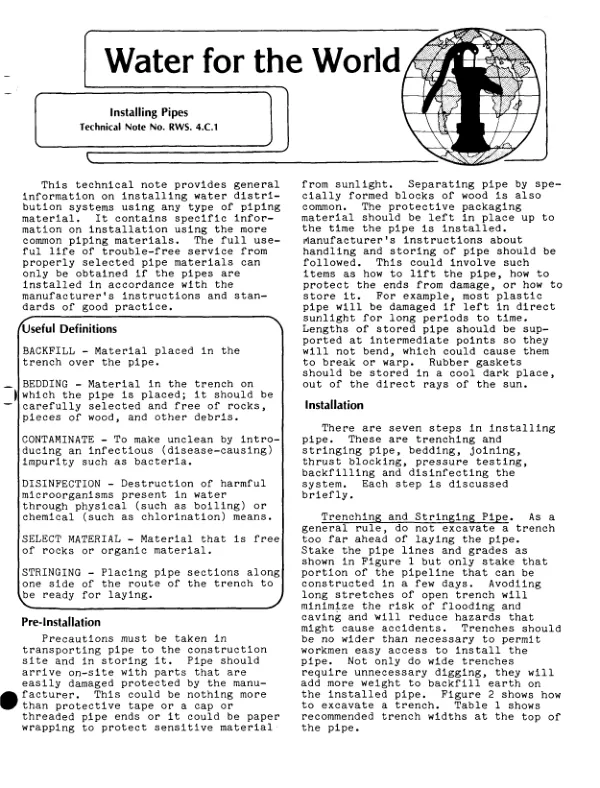
Technical Note No. RWS. 4.C.1: Installing Pipes
Installing water distribution systems using any type of piping material requires careful consideration of several factors to ensure the pipes are installed in accordance with the manufacturer's instructions and standards of good practice.
2022 · 8 pages
Sign in to readA free account is required to download.
Abstract
The full useful life of trouble-free service from properly selected pipe materials can only be obtained if the pipes are installed correctly. Pipe materials should be free of rocks or organic material, and the bedding material in the trench should be carefully selected and free of rocks, pieces of wood, and other debris. The trench should be excavated to a depth that allows for the pipe to be buried deep enough to prevent freezing and protect it from surface activity, vehicle loads, and high temperatures caused by the sun. A minimum depth cover of 60cm will provide adequate protection. The installation of pipes involves seven steps: trenching and stringing pipe, bedding, joining, thrust blocking, pressure testing, backfilling, and disinfecting the system. Each step is crucial in ensuring the pipes are installed correctly and the system functions properly. Trenching and stringing pipe should be done carefully to avoid flooding and caving, and the trench should be no wider than necessary to permit workmen easy access to install the pipe. The bedding material should be level, free of rocks, and preferably free of loose material that can easily conform to the shape of the pipe. At couplings and fittings, a small depression in the trench bottom should be made to ensure the pipe will not "bridge" from coupling to coupling. If the excavated material has rocks, a "select" material must be used to lay the pipe on a bed of soil and to backfill the trench. Joining pipe lengths and fittings requires following the manufacturer's instructions, and attention should be paid to the types of solvents or "glues" to be used on plastic pipes, as they are not all the same. Gaskets used in various slip type couplings and mechanical joints may look similar but are not interchangeable. Pipe ends, gaskets, and couplings should be clean before assembly, and grease can prevent a plastic pipe solvent from sealing tightly. Thrust blocking is necessary for all pipe materials and joints, particularly when a slop coupling and gasket is used. Thrust blocks should be used at fittings, bends, and pipe ends to prevent pipe movement due to water pressure. The size of the thrust block is determined by the pipe size, type of fitting, water pressure, and soil stability, and manufacturer's literature should be consulted for design information. In rural systems, a concrete block that provides a full bearing surface to the fitting and extends to undisturbed earth is sufficient. Longitudinal forces can result from thermal expansion or contraction of pipe material, and an extreme case may occur when polyethylene pipe is installed on a very hot day and then filled with cold water. The force of contraction could pull joints apart, and thrust blocks should be used to prevent this.
Related documents
Documents in this collection
USAID DEC
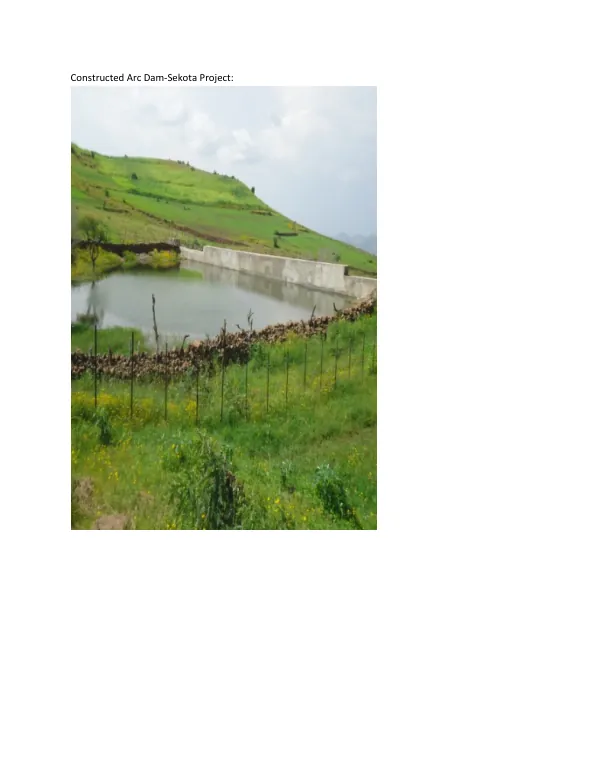
Constructed Arc Dam-Sekota Project: Demonstration, Educational Drama show-Wadla, Hand washing day Celebration with Students-Laygayint project, Hand washing day celebration-Wadla, Irish Potato production on a backyard-Wadla, Practical training for mothers on horticulture-Dehana Project, Practical training on Composting-Lasta, Review meeting, Vegetable Production-Wadla, Video show screening, Mother taking care for poultry-Lasta, Mothers' training on local seed supply system-Dehana, Potable Water supply-Bugna before and after 1, Potable Water supply-Bugna before and after 2
Open record 2018
2018USAID DEC
![Inventory of HIV/AIDS counselling, testing, care and support services in Nairobi[, Kenya]](https://covers.devme.ai/gen/140571.webp)