USAID
Cost-Effectiveness Analysis Protocol for Safe Love Campaign in Zambia
The Safe Love campaign in Zambia aimed to prevent the spread of HIV by targeting four domains of behavior change: increasing condom use, decreasing multiple concurrent partnerships, and increasing voluntary male circumcision.
2015 · 5 pages
Sign in to readA free account is required to download.
Abstract
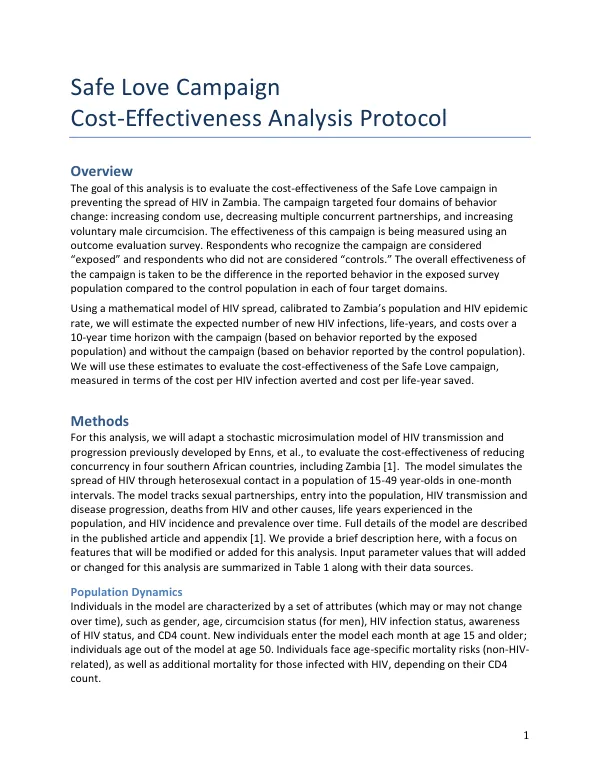
The campaign's effectiveness was measured using an outcome evaluation survey, with respondents who recognized the campaign considered "exposed" and those who did not considered "controls." The overall effectiveness of the campaign was taken to be the difference in reported behavior in the exposed survey population compared to the control population in each of the four target domains. A mathematical model of HIV spread was used to estimate the expected number of new HIV infections, life-years, and costs over a 10-year time horizon with and without the campaign. The model, adapted from a previous study by Enns et al., simulated the spread of HIV through heterosexual contact in a population of 15-49 year-olds in one-month intervals. The model tracked sexual partnerships, entry into the population, HIV transmission and disease progression, deaths from HIV and other causes, life years experienced in the population, and HIV incidence and prevalence over time. The model was calibrated to match historic HIV prevalence trends in Zambia prior to the introduction of the Safe Love campaign in 2011. To do this, the model was run for the base case scenario (no intervention), using historic prevalence data and survey responses among the control population in the Safe Love campaign outcome evaluation survey where appropriate. Uncertain parameters were adjusted until the HIV prevalence projected by the model matched that observed in reality over the calibration period (2005-2010). Two scenarios were simulated: one where the intervention was not in place (Base Case) and the other where the Safe Love Campaign was in place (Intervention). The Base Case scenario was parameterized using the levels of condom use, number of sexual partners, and prevalence of circumcision reported by the control population in the evaluation survey, while the intervention scenario was simulated using the quantities reported by the exposed population in the outcome evaluation survey. The model outputs the expected number of infections, number of life-years accrued in the population, and the total healthcare (and intervention) costs over the 10-year time horizon. The expected number of infections averted and life-years saved by the Safe Love campaign was calculated by taking the difference in outcomes between the Base Case and Intervention scenarios. Measures of cost-effectiveness, including the cost per HIV infection averted and per life-year saved, were computed and compared against standard cost-effectiveness thresholds or against the efficiency of other HIV prevention programs. The model parameters and sources are listed in Table 1, including population demographics, prevalence of male circumcision, HIV progression, diagnosis, and treatment, sexual behaviors, and costs. The template for model outcomes and cost-effectiveness results is provided in Table 2.