DELOITTE INC.
Côte d’Ivoire Study on the National Willingness-to-Pay for Electricity
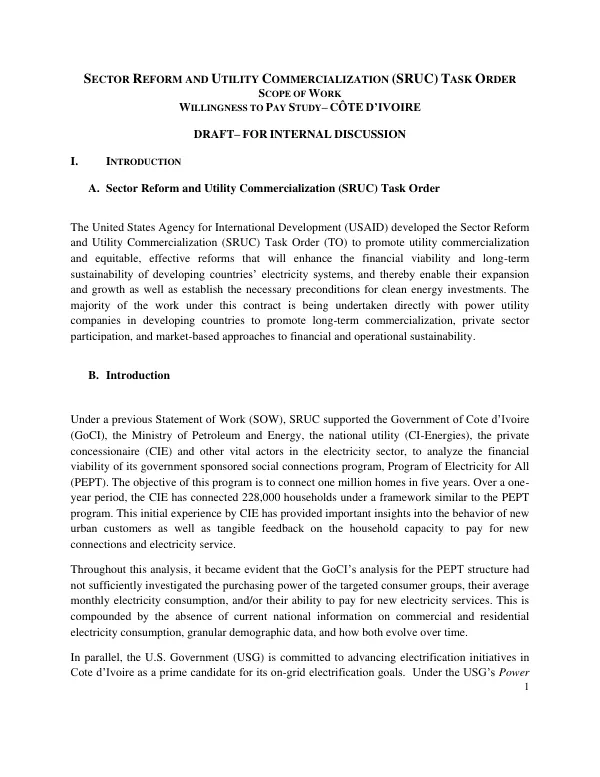
The national regulator, Autorité Nationale de Régulation du Secteur de l'Electricité (Anare), in Côte d'Ivoire (CdI) requested technical and financial support from USAID to conduct a national study on the willingness-to-pay (WTP) of households and businesses for electricity services.
2018 · 23 pages
Sign in to readA free account is required to download.
Abstract
The study aimed to provide Anare with reliable WTP information to review electricity tariffs and adjust them accordingly. Deloitte, as a contractor to USAID, designed and managed the WTP project, which involved surveying 4,800 households and 560 businesses in 5,000 localities across CdI. The study captured a nationwide representative sample of consumers' willingness-to-pay for dependable, high-quality electricity services. The survey interviewed a wide range of households, from families connected directly to the national grid to residents with no access to the grid. The study also surveyed small and medium-sized businesses connected to the grid across the entire spectrum of CdI's economy. Deloitte reviewed and analyzed the information gathered to understand the main drivers behind Ivoirians' willingness-to-pay and model WTP across different segments of the population. The study found that tariffs in CdI do not recover all costs associated with electricity production and distribution. The 2014 Electricity Code provides a path towards energy efficiency, independent regulatory oversight, and improved customer service, mandating the Government of Côte d'Ivoire (GoCI) to work towards improved financial sustainability for the electricity sector. The study identified post-paid versus prepaid electricity subscriptions as a key issue in CdI, with CIE offering three types of prepaid schemes and five types of post-paid subscriptions. Additional charges, such as taxes and fees, are levied on electricity usage, with approximately 25% of the price of a kilowatt-hour (kWh) comprised of taxes and fees for the LV Social Tariff. The study also highlighted the regulatory framework for tariff setting in CdI, with Anare responsible for proposing electricity tariffs and connection charges, but the GoCI ultimately responsible for setting tariffs and various charges based on Anare's and other stakeholders' inputs. Anare's capacity and capability to regulate private operators and protect users have improved over time, with the 2014 Electricity Code increasing Anare's powers and independence. The decree n° 2016-785 in 2016 established Anare as a truly independent regulator, Anare-CI, with no direct oversight from the Ministry of Energy. Anare's powers were significantly expanded, and its independence reinforced, with decision-making, control, oversight, investigation, arbitration, and enforcement powers granted. The study's results and insights were intended to inform Anare of the various impacts of WTP studies on tariffs and tariff methodologies, government policies, and rural/regulatory implications. Deloitte also summarized international leading practices and academic research on tariff setting mechanisms that include, but are not limited to, WTP inputs. The study's findings and recommendations were intended to help Anare build the skills needed to enable its broader mission as a regulator.
Related documents