AMERICAN NATIONAL STANDARDS INSTITUTE
Final Report: 2013-2021
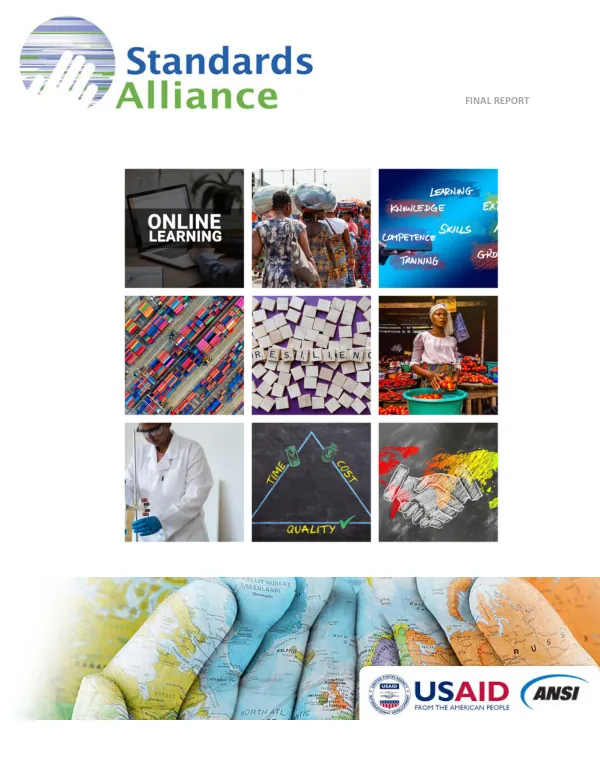
The Standards Alliance is a public-private partnership between the American National Standards Institute (ANSI) and the U.S.
2021 · 174 pages
Sign in to readA free account is required to download.
Abstract
Agency for International Development (USAID). The partnership was announced by USAID in November 2012 as a new funding facility designed to provide capacity-building assistance to developing countries, specifically related to the implementation of the World Trade Organization (WTO) Technical Barriers to Trade (TBT) Agreement. The original ANSI-USAID agreement covered a planned 5-year initiative, funded 50% by USAID and 50% by ANSI and other private sector partners. During the first year of the Standards Alliance, ANSI and USAID selected ten countries/regions for engagement and ANSI conducted initial assessments with each partner, establishing individual work plans for each country/region. In the program's third year (2016), five additional countries were added to support the expansion of the Trade Africa initiative. From 2018 until the end of the program, the Standards Alliance worked only in the five African countries: Ghana; Côte d'Ivoire; Senegal; Zambia; and Mozambique. The Standards Alliance focuses on continually building participating countries' capacity to fulfill WTO obligations and increasing practical knowledge on the WTO TBT Agreement. As a major part of this effort, the Standards Alliance engages partner countries on the development and implementation of international standards and best practices for conformity assessment, amongst other topics. These standards and conformity assessment procedures are foundational to the global trade system and efforts under the Standards Alliance help cultivate self-reliance, as well as fertile ground for reciprocal, two-way trade between the U.S. and Standards Alliance partner countries. Over the past 8 years, the Standards Alliance has supported sustainable partnerships and promoted self-reliance through targeted assistance to develop quality infrastructure and institutions that support strong quality systems. These efforts help bolster market confidence and expand market access by decreasing barriers to trade, increasing transparency, improving regulatory developments, and fostering market predictability. These efforts also contribute to health and safety improvements of consumers in participating countries through increased understanding and utilization of international best practices for consumer products. In year 7, the Standards Alliance restructured its work plan activities, organizing them into three strategic pillars: (I) Transparency (notification, stakeholder engagement); (II) National Quality Infrastructure (international standards, good regulatory practices and regulatory impact assessment); and (III) Resilience (building institutional and government capacity). Since 2013, the Standards Alliance completed 114 TBT-related trainings, undertook 5 detailed policy diagnostics, and completed 1 long-term advisory project. Training events alone included more than 5,800 participants from over 70 countries (including regional participation). These activities advanced U.S. business interests in a variety of export categories, paved the way for U.S. investment, and helped partner countries move a step forward in their path towards self-reliance. Examples of the Standards Alliance's achievements include the development of several strong sectoral training modules, such as the U.S.-Central America Conference on Textiles Standards and Customs Procedures, carried out in Guatemala in June 2015. A 2-day training course on the standards, regulations, and customs procedures that guide exports of textile products to the U.S, and all U.S. experts expressed strong interest in carrying out similar training activities in other Standards Alliance countries. In addition, Standards Alliance training conducted in Peru in 2016 focused on standards and regulatory practices for medical devices, showing a shift towards higher-value products as well as trends toward adoption across the region. The Standards Alliance has also expanded its visibility and impact at the national, regional, and continent-level, highlighting the growth in strategic significance of the program and its projects over the past 8 years. Annex A-1 contains information about regional and international participation and trade impacts that the Standards Alliance gathered during updates to the needs assessments conducted in 5 African countries.
Related documents