USAID DEC
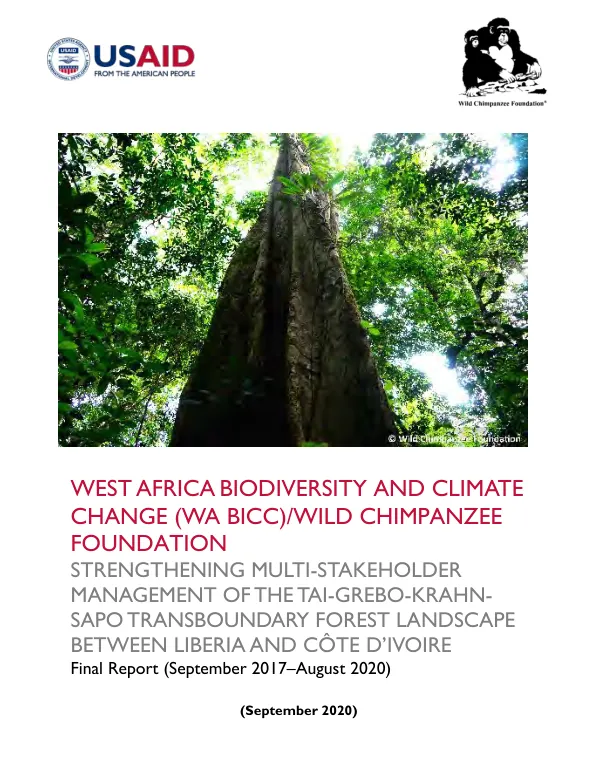
Strengthening Multi-Stakeholder Management of the Tai-Grebo-Krahn-Sapo Transboundary Forest Landscape Between Liberia and Côte D’Ivoire
Sign inTETRA TECH
Strengthening Multi-Stakeholder Management of the Tai-Grebo-Krahn-Sapo Transboundary Forest Landscape Between Liberia and Côte D’Ivoire
The Taï-Grebo-Krahn-Sapo (TGKS) Transboundary Forest Landscape is a critical ecosystem spanning across Liberia and Côte d'Ivoire.
2021 · 90 pages
Sign in to readA free account is required to download.
Abstract
The landscape is home to a diverse array of flora and fauna, including the critically endangered chimpanzee. The TGKS landscape is also a vital source of livelihoods for local communities, who rely on the forest for their economic and social well-being. The project, supported by the USAID West Africa Biodiversity and Climate Change program, aimed to strengthen multi-stakeholder management of the TGKS landscape. The project's overall objective was to promote effective interventions that strengthen forest conservation, protect biodiversity, and improve the connection between the forest blocks in each country and between the two countries. To achieve this objective, the project focused on four key areas: (1) gathering and sharing baseline information on the TGKS landscape, (2) enhancing biodiversity assessment and biomonitoring, (3) identifying potential corridors within the TGKS landscape that strengthen biodiversity conservation, and (4) strengthening protected area management. The project made significant progress in these areas. Baseline information on the TGKS landscape was gathered and shared, providing a foundation for future conservation efforts. Biodiversity assessment and biomonitoring were enhanced, allowing for a better understanding of the landscape's ecological health. Potential corridors within the TGKS landscape were identified, which will help to strengthen biodiversity conservation. The project also made progress in strengthening protected area management. The project worked with local communities and government agencies to develop and implement effective management plans for the TGKS landscape. This included the establishment of community ecoguards, who played a critical role in protecting the forest and its resources. In addition to these achievements, the project also contributed to a strong collaboration among stakeholders, including local communities, government agencies, and international organizations. This collaboration was essential for the project's success, as it allowed for the sharing of knowledge, resources, and expertise. The project's impact on communities' knowledge, attitudes, and behavior was also significant. The project implemented a range of activities aimed at promoting sustainable forest management and conservation practices among local communities. These activities included training programs, community outreach, and income-generating activities. The project's findings and recommendations are presented in the following sections. The project's lessons learned, challenges, and opportunities are also discussed, providing valuable insights for future conservation efforts in the TGKS landscape. The project's enabling environment and policy framework are also discussed, highlighting the importance of a supportive policy environment for conservation efforts. The project's potential impacts and sustainability are also explored, providing a roadmap for future conservation efforts in the TGKS landscape. Overall, the project made significant progress in strengthening multi-stakeholder management of the TGKS landscape. The project's achievements and lessons learned provide valuable insights for future conservation efforts in the TGKS landscape and beyond.