INTERNATIONAL INSTITUTE FOR ENVIRONMENT AND DEVELOPMENT
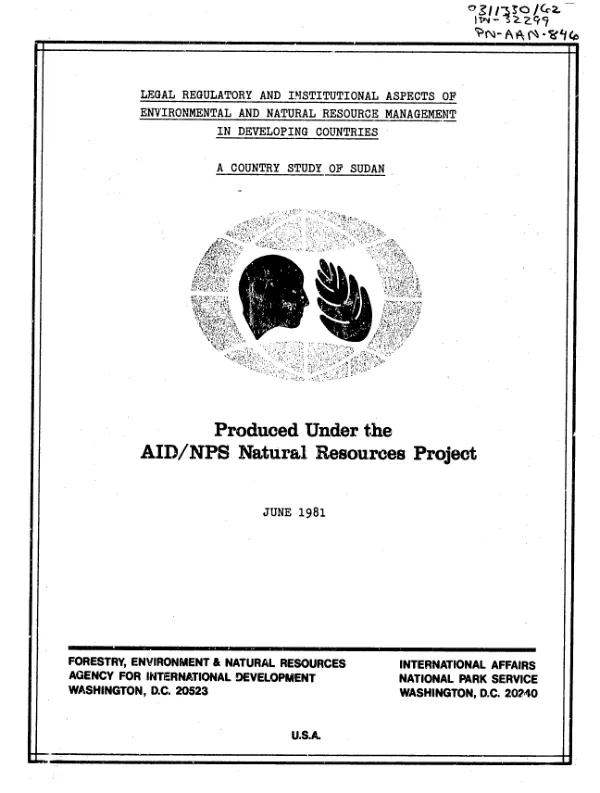
Country study of Sudan
Desertification, the negative health impact of irrigation programs, excessive pesticide and fertilizer use, aquatic weed infestation, wildlife depletion, and degradation of the Red Sea ecology are the major problems besetting Sudan"s attempt to manage its vast natural and environmental resources.
Johnson, Brian; Ofosu-Amaah, Waafas · 1981
Sign in to readA free account is required to download.
Abstract
The legal, regulatory, and institutional aspects of that management effort are the subject of this report. Individual chapters are devoted to governmental structure and the legal system, attitudes towards law, natural resource and environmental policy, and Government of Sudan resource management entities. Major legislative provisions are discussed for 10 major resource sectors. Discussion is also given to international agreements on the use of Nile waters and the increasing involvement of nongovernmental organizations in environmental and natural resources management. Despite growing governmental concern, sound management continues to be constrained by: (1) a severe lack of intragovernmental coordination; (2) conflicts regarding land use, compounded by a lack of information on the country"s natural resources; (3) the power of local authorities, which may be further complicated by the planned decentralization program; and (4) the outdatedness and lack of enforcement of the majority of environmental laws. Recommendations are made concerning all these issues. A 6-page bibliography (1955-80) is appended.
Connected topics
Related documents