U.S. LIBRARY OF CONGRESS. SCIENCE AND TECHNOLOGY DIV.
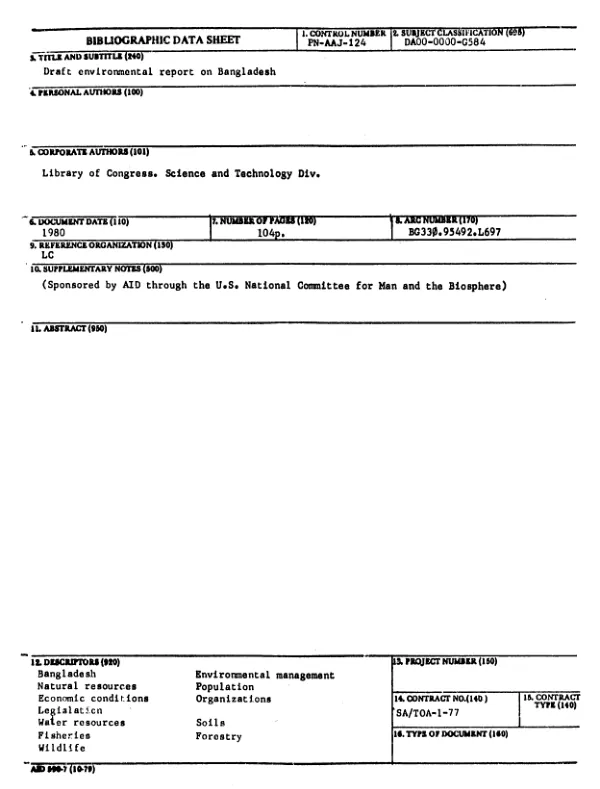
Draft Environmental Report on Bangladesh
Bangladesh is one of the most densely populated countries in the world -- a situation that has placed tremendous pressures on its natural resource base.
1970
Sign in to readA free account is required to download.
Abstract
This draft report discusses the nation"s plight while profiling its resources of water, soils, forests, wildife, coastlands, fisheries, and minerals, as well as its climatic and geographic characteristics. Complementing these resource profiles are examinations of the country"s environmental organizations and legislation, and its demographic and economic characteristics. Overpopulation is the critical problem confronting Bangladesh; there is an immediate need to slow the nation"s 2.9% growth rate. Due to the nation"s limited water storage facilities, only 10% of the population has access to potable water despite the overbundance of water during the monsoon season. This situation contributes to low agricultural productivity and the rapid spread of communicable diseases. About 50% of the population suffers from malnutrition in addition to intestinal diseases and parasitic maladies such as malaria. The most prominent water quality problem is contamination of domestic water by human waste. Water is also contaminated by fertilizer and pesticide residues and industrial wastes, especially in the southeast and around Dacca. Farming area is also inadequate. Since most arable lands are already under cultivation (thus severely limiting the area for grazing), increased agricultural output depends on expanded irrigation operations and the use of fertilizers and pesticides. Soil erosion caused by monsoon flooding and hill farming is continuous. Deforestation, due to fuelwood gathering and agricultural clearing, has left only 15% of the nation"s forests intact. Wildlife has also suffered as society reduces their habitat. Rhinoceri, elephants, and crocodiles are endangered. Coastlands are inundated by saline waters, while exploitation of mangrove swamps in the southwest for fuelwood threatens the area"s ecological patterns. The nation"s fishery and mineral resources are considered underdeveloped. A 33-item bibliography (1971-79) in English and German is appended.