DAI GLOBAL, LLC
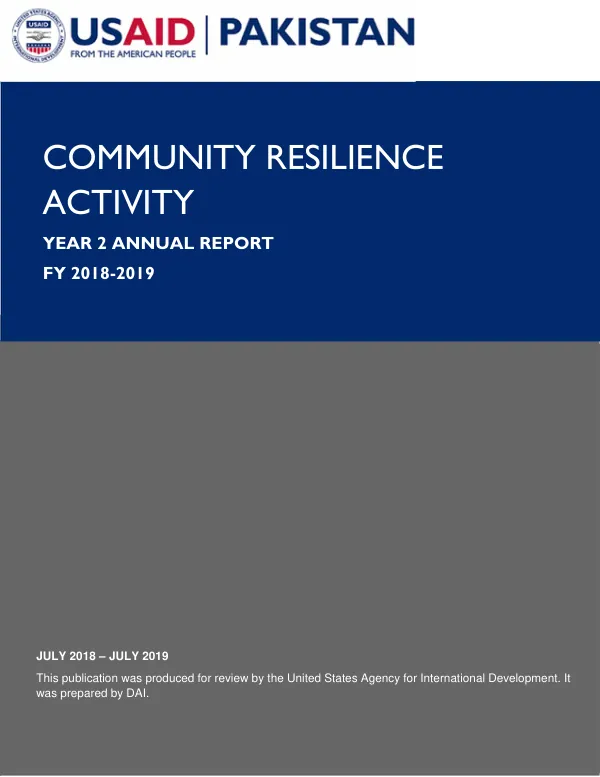
CRA Year 1 Annual Report
Pakistan's Community Resilience Activity (CRA) is a USAID-funded program implemented by DAI Global LLC in Pakistan.
2019 · 58 pages
Sign in to readA free account is required to download.
Abstract
The program aims to increase stability in target areas by strengthening communal resilience to violent extremist (VE) influence. The CRA's initial geographic scope includes Karachi, Northern Sindh, and southern Punjab provinces. The program's overarching goal is to increase stability in target areas, with a purpose to increasing resilience in targeted communities vulnerable to violent extremism. To achieve this goal, CRA intervention areas focus on building resilience by mobilizing a cross-section of Pakistani society to actively and directly work together to reduce violence and increase cohesion and tolerance across sub-groups in communities. CRA's program-level objectives include increasing broad-based citizen engagement in community decision-making and enhancing tolerance within and across communities. To address local-level VE issues, CRA has suggested regional objectives for Karachi, Northern Sindh, and Southern Punjab, including increasing acceptance of diverse backgrounds, promoting youth-led initiatives, and increasing engagement of universities and civil society on CVE initiatives. Pakistan's political and security situations remained unstable during the reporting period due to several incidents, events, and reasons. The major ones include the 13th General Elections 2018, the rise of extremist political parties, and the Aasia Bibi blasphemy case verdict and action against TLP. The elections saw the emergence of religious political parties with extremist views, including Tehreek e Labbaik Pakistan (TLP), which grabbed the fifth place in terms of total votes cast for the National Assembly. The Aasia Bibi case verdict resulted in violent rallies in several areas of the country, and the government cracked down against the TLP and its top leadership. The acquittal of Aasia Bibi led to protests by the TLP, which has extremist views on the implementation of blasphemy laws. The situation highlights the need for CRA's efforts to strengthen communal resilience to VE influence and promote social cohesion in target areas. CRA's first year of programming focused on establishing key implementation systems to ensure effective programming over the next three years. The program transitioned into full implementation phase after completing the hirings for all its positions. CRA received approval for the Year 2 Annual Workplan, CRA Sustainability Plan, and strategy documents for each of its programming clusters in the three regions. By the end of the second year of programming, CRA committed roughly $X million and disbursed approximately $Y million. The program team conducted its second Strategy Review Session (SRS) in Islamabad to reflect on the strategy in light of the lessons emerging from field research and experience. The discussions focused on expanding areas of programming, promoting cross-regional learnings, and identifying ways to refine the strategies and indicators to achieve maximum impact. CRA's program description highlights the need to promote security and stability in Pakistan, in line with the Government of Pakistan's commitment to increasing stability and security within its national boundaries. The program aims to strengthen communal resilience to VE influence by increasing citizens' engagement in their community's decision-making, building acceptance within and across communities, and creating linkages between communities and the government to promote social cohesion.
Related documents