DAI GLOBAL, LLC
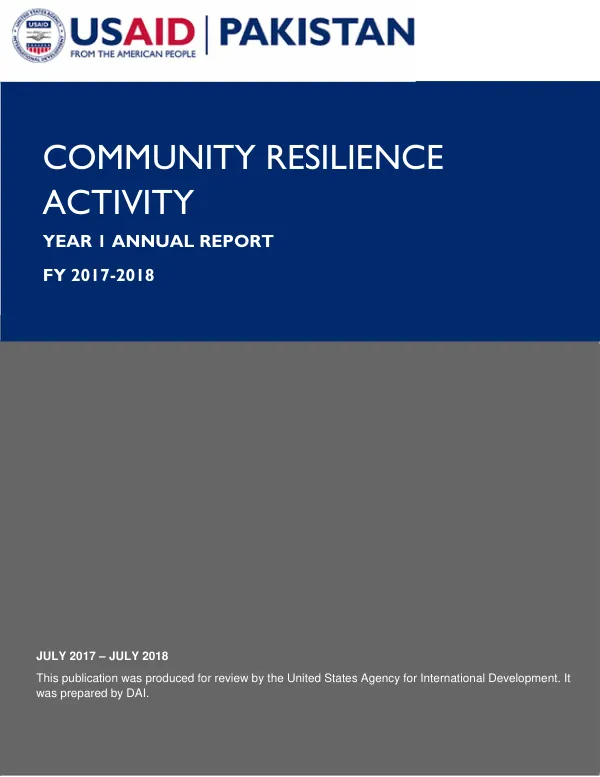
CRA YEAR 1 ANNUAL REPORT
Pakistan's political and security situations remained unstable due to several incidents, events, and/or reasons since the inception of the project in June 2017.
2018 · 24 pages
Sign in to readA free account is required to download.
Abstract
The major incidents include the disqualification of Pakistani Prime Minister Nawaz Sharif in July 2017, the caretaker government setup in preparation for the upcoming general elections, and the escalation of hate narratives with the emergence of Tehreek Labbaik Ya Rasool (TLYR). The disqualification of Prime Minister Nawaz Sharif resulted from the ongoing Panama Papers investigation, which started in April 2016. The Supreme Court disqualified the Prime Minister for life from serving as PM on July 28, 2017. The ruling party, Pakistan Muslim League (PML-N), accepted the SC's decision but demonstrated their show of power through a massive road rally from Islamabad to Lahore and publicly criticized and accused the SC and the country's judiciary of conspiring against the ruling party. The second quarter of 2018 was marked by the end of PML-N-led government's five-year tenure, and the country moved towards a caretaker setup in preparation for the upcoming general elections, which were held on July 25, 2018. After a lot of deliberation between the government and opposition led by PPP, Former Chief Justice of Pakistan, Justice Retd. Nasir ul Mulk was appointed as the caretaker Prime Minister of Pakistan. In Punjab, the transition of power to a caretaker government setup was difficult as the government and opposition led by Pakistan PTI could not agree on a single name for the caretaker Chief Minister (CM) Punjab. Eventually, the ECP nominated Dr. Hasan Askari Rizvi as the caretaker CM for Punjab on June 7. In Sindh, an interim provincial government was finalized in May after extensive negotiations between Sindh's provincial government and the opposition. On June 2, Fazal-ur-Rahman was sworn in as the caretaker Chief Minister of Sindh, while his cabinet took oath on May 28. The escalation of hate narratives with the emergence of Tehreek Labbaik Ya Rasool (TLYR) in November 2017 also contributed to the unstable security situation in Pakistan. A religious group, TLYR, organized a massive sit-in of 22 days in Islamabad to demand the resignation of lawmakers that allegedly supported members of the Ahmadiyya community. The Community Resilience Activity (CRA) aims to strengthen communal resilience to violent extremist influence by increasing citizens' engagement in their community's decision-making, building acceptance within and across communities, and creating linkages between communities and the government to promote social cohesion. The CRA's initial geographic scope is Karachi, Northern Sindh, and southern Punjab provinces. However, since VE dynamics are fluid in nature, CRA may expand or relocate to other parts of Pakistan as conditions or opportunities emerge. The CRA's overarching goal is to increase stability in target areas, with a purpose to increasing resilience in targeted communities vulnerable to violent extremism. This will contribute to building a foundation for political and social development in conflict-prone communities in Pakistan. To achieve this goal, CRA has set several program objectives, including increasing broad-based citizen engagement in community decision-making, enhancing tolerance within and across communities, and promoting an environment in target areas that is less conducive to the influence of VE groups. CRA's program level objectives are to increase broad-based citizen engagement in community decision-making, enhance tolerance within and across communities, and promote an environment in target areas that is less conducive to the influence of VE groups. To address local level VE issues, CRA has suggested several regional objectives/intermediate results (IRs) for Karachi, Northern Sindh, and Southern Punjab, including increasing acceptance of diverse backgrounds in targeted communities, increasing youth-led initiatives in support of civic action and social responsibility, and increasing positive interactions between CSOs and district governments. CRA will keep the above-mentioned objectives flexible and subject to change due to emerging trends and issues in the CVE domain. This flexibility will allow the CRA team to develop program activities to address evolving issues in the target areas.
Related documents