CONCERN WORLDWIDE INTERNATIONAL
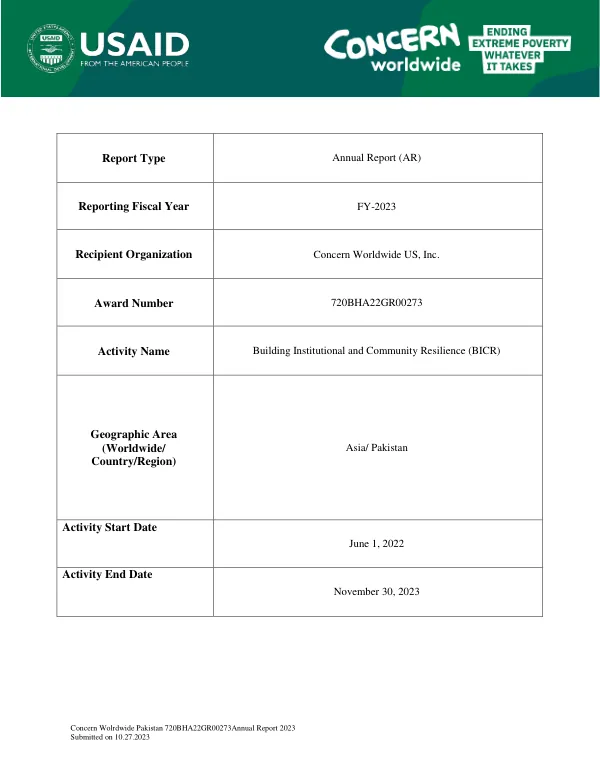
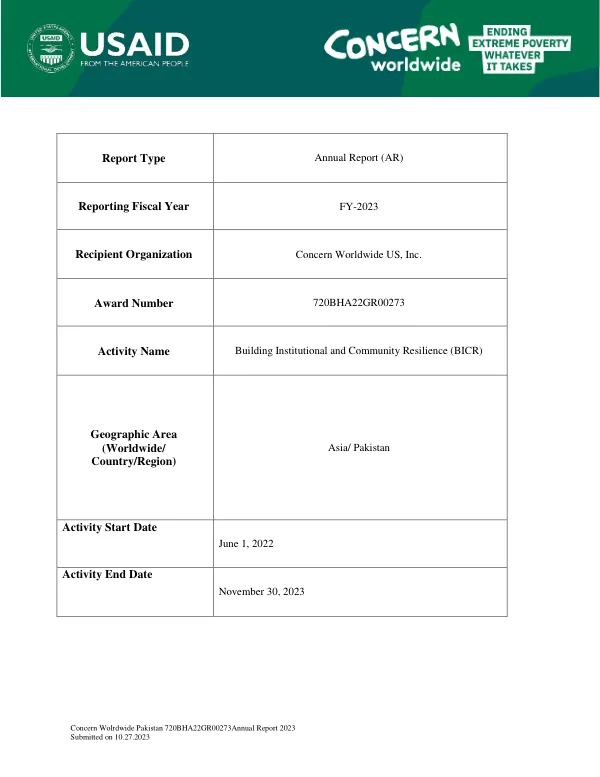
Annual Report 2023: Building Institutional and Community Resilience (BICR)
The Building Institutional and Community Resilience (BICR) project is a 18-month initiative implemented by Concern Worldwide in Khyber Pakhtunkhwa (KP), Sindh, and Gilgit Baltistan (GB) provinces.
2023 · 19 pages
Sign in to readA free account is required to download.
Abstract
The project aims to build institutional capacities of government and national NGOs in KP and GB, and resilience of highly vulnerable communities in Sindh to recurring hazards through improved preparedness and response capacities. Concern is partnering with the National Institute of Disaster Management (NIDM) and Community World Services South Asia (CWSA) for the institutional capacity building of NGOs and DMAs in KP and GB provinces. The project is also partnering with two local NGOs, Sukaar Foundation and SAMI Foundation, for implementing resilience building activities at the community level in districts Umerkoat and Tharparkar of Sindh province. The project is strengthening the technical, management, and programmatic skills of local NGOs and DMAs to increase the quality of their internal operations and the efficacy of disaster preparedness and response work on the ground. Investments in national capacity development will strengthen local ownership and institutional competence of NGOs and DMAs in target geographical regions. Concern has made substantial progress in the reporting period, benefiting 60,072 people, including 32,074 (53%) women and 27,998 (47%) men, through integrated support. The project has built the institutional capacity of 28 NGOs and 2 provincial-level Disaster Management Authorities, PDMA KP and GBDMA. Concern has also built the capacity of officials on SIMEX, firefighting, prevention, and mitigation from the DMAs and other government officials from line departments in 8 districts in KP and GB. In the reporting period, Concern successfully completed Counter Terrorism (CT) checks and conducted capacity assessments for 28 shortlisted NGOs in KP province. Memorandums of Understanding (MOUs) were executed with each of the NGOs in KP for Humanitarian Response Capacity Development. The capacity assessments for the selected NGOs were conducted to identify specific needs aligned with the program's mandate, resulting in the formulation of individualized capacity-building plans. Concern Worldwide organized inception meetings with the senior management teams of the aforementioned 28 NGOs in KP, offering comprehensive orientation regarding the objectives and processes entailed in the capacity-building component. Additionally, Concern Worldwide entered into an MOU with Community Worldwide Service Asia (CWSA) to jointly enhance the capabilities of NGOs and DMAs in KP and Gilgit-Baltistan (GB) with a focus on Quality and Accountability to Affected Population (Q&AAP). In collaboration with CWSA, Concern conducted a total of four training sessions on Q&AAP for these 28 NGOs in KP, attended by a total of 73 participants, comprising 60 men and 13 women. Moreover, CWSA provided coaching and mentoring support to the 28 selected NGOs in KP to develop or refine their respective Codes of Conduct (COC) and Complaint Response Mechanism (CRM) policies. During the reporting period, CWSA successfully finalized Code of Conduct (CoC) manuals for 18 organizations and CRM policies for 13 organizations. The review process for the remaining NGO documents is currently in progress and will be completed in the remaining project period. To strengthen the institutional capabilities of Disaster Management Authorities (DMAs), Concern Worldwide formalized an Agreement of Understanding (AOU) with the National Disaster Management Authority (NDMA) to enhance the capacity of DMAs in KP and GB. Concern has also built the capacity of officials on SIMEX, firefighting, prevention, and mitigation from the DMAs and other government officials from line departments in 8 districts in KP and GB. The project has also focused on building community resilience by integrating community-based disaster risk management (CBDRM) through disaster preparedness and risk mitigation in countering the disproportionately negative effects of disasters on vulnerable communities. The project has made significant progress in the reporting period, with a total of 60,072 people benefiting from the integrated support. The project has also built the institutional capacity of 28 NGOs and 2 provincial-level Disaster Management Authorities, PDMA KP and GBDMA. Concern has also built the capacity of officials on SIMEX, firefighting, prevention, and mitigation from the DMAs and other government officials from line departments in 8 districts in KP and GB. The project has also focused on building community resilience by integrating community-based disaster risk management (CBDRM) through disaster preparedness and risk mitigation in countering the disproportionately negative effects of disasters on vulnerable communities. The project has made significant progress in the reporting period, with a total of 60,072 people benefiting from the integrated support.