USAID DEC
Credit Market Consequences of Improved Personal Identification: Field Experimental Evidence from Malawi
Sign inMICHIGAN STATE UNIVERSITY FOUNDATION
Credit Market Consequences of Improved Personal Identification: Field Experimental Evidence from Malawi
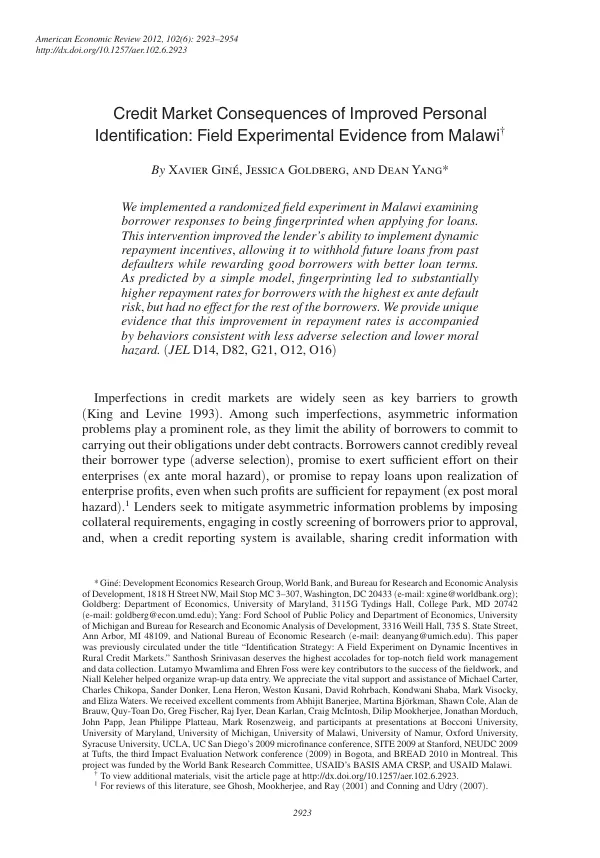
Improved personal identification through fingerprinting has been implemented in Malawi to examine its impact on credit market behavior.
2012 · 32 pages
Sign in to readA free account is required to download.
Abstract
The experiment was conducted in a rural area where access to credit is limited, and the identification system is imperfect. Farmers who applied for agricultural input loans to grow paprika were randomly assigned to either a control group or a treatment group where each member had a fingerprint collected as part of the loan application. The treatment group allowed lenders to construct accurate credit histories and condition future lending on past repayment performance. This improved borrower identification enabled lenders to make their threats of future credit denial and promises of larger future loans more credible. The experiment aimed to shed light on the impact of improved personal identification on borrower and lender behavior, the prevalence of adverse selection and moral hazard in the credit market, and the operation of credit bureaus. Malawi ranked 109 out of 129 countries in terms of private credit to GDP, a frequently used measure of financial development. The country also received low marks in the "depth of credit information index," which proxies for the amount and quality of information about borrowers available to lenders. Few rural Malawian households have access to loans for production purposes, with only 11.7 percent reporting any production loans in the past 12 months, and among these loans, only 40.3 percent were from formal lenders. The experiment's results showed that fingerprinting led to substantially higher repayment rates for borrowers with the highest ex ante default risk. However, it had no effect for the rest of the borrowers. The improvement in repayment rates was accompanied by behaviors consistent with less adverse selection and lower moral hazard. The results suggest that improved personal identification can mitigate asymmetric information problems and raise repayment rates. The experiment's findings have implications for the operation of credit bureaus. A unique identification system is necessary for a credit bureau to function effectively. In countries where large segments of the population lack formal identification documents, lenders accept different forms of identification, which can lead to difficulties in tracking customers across multiple lenders and identifying defaulters within their own client base. Improved personal identification can help lenders to sanction unreliable borrowers and reward reliable borrowers with expanded credit. The Indian government has embarked on a vast effort to fingerprint and assign personal identification numbers that will replace all other forms of identification and enable citizens to access credit markets, public services, and subsidies on food, energy, and education. The experiment's results provide empirical evidence on the impacts of improved personal identification in credit markets, which can inform policy decisions in countries seeking to improve their identification systems.
Related documents
Documents in this collection
 2017
2017USAID DEC
Composition and variation of fatty acids among groundnut cultivars in Uganda
Open record 2018
2018USAID DEC
An Evaluation of the Level of Integration and Alignment of the Malabo Commitments, Africa’s Agenda 2063 and the SDGs in 10 National Agriculture and Food Security Investment Plans
Open record