FLORIDA INTERNATIONAL UNIVERSITY
Associate Award Research Annual Performance Report
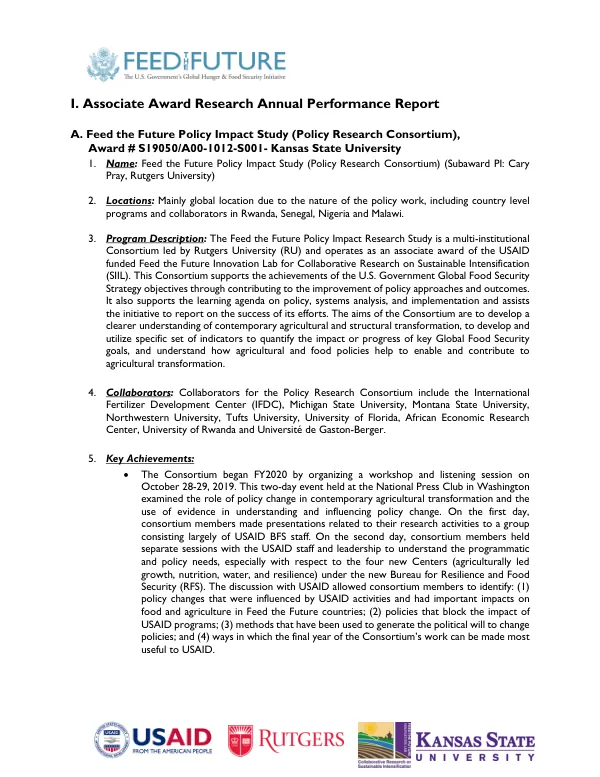
The Feed the Future Policy Impact Study is a multi-institutional Consortium led by Rutgers University, operating as an associate award of the USAID-funded Feed the Future Innovation Lab for Collaborative Research on Sustainable Intensification.
2021 · 6 pages
Sign in to readA free account is required to download.
Abstract
The Consortium's primary objective is to contribute to the improvement of policy approaches and outcomes, supporting the U.S. Government Global Food Security Strategy objectives. The study aims to develop a clearer understanding of contemporary agricultural and structural transformation, quantify the impact of key Global Food Security goals, and understand how agricultural and food policies enable and contribute to agricultural transformation. The Consortium's research activities focus on policy change in contemporary agricultural transformation and the use of evidence in understanding and influencing policy change. A workshop and listening session were organized in October 2019, examining the role of policy change in contemporary agricultural transformation and the use of evidence in understanding and influencing policy change. The event brought together consortium members, USAID BFS staff, and leadership to discuss policy needs, especially with respect to the four new Centers under the new Bureau for Resilience and Food Security. The Consortium has made significant progress in various areas, including the development of policy guidelines on how to address the COVID-induced disruption on agri-food systems in developing countries. The guidance and associated policy matrix were made available to USAID Missions to help them understand policy choices in dealing with COVID. The Consortium's support to Dr. Sera Young at Northwestern and the HWISE indicator has also made considerable progress, with IFPRI deciding to implement the short form of the HWISE scale in panel surveys about COVID impacts in 8 countries. The Consortium has successfully shifted many of its activities towards more COVID-related issues, including the COVID surveillance project, which provides a proof of concept on how to create a surveillance metric that corrects for measurement error and data contamination to determine when it is safe to reopen in various countries. The Consortium has also engaged in weekly planning meetings via phone, with nearly 50 individuals from within USAID and partners in the World Bank and IFPRI participating. Eight new policy briefs were written for distribution at the event. Capacity building is a key aspect of the Consortium's work, with various students working with researchers as RAs. The Consortium has supported the thesis writing stage of 7 students enrolled in the Combined Masters in Agricultural and Applied Economics (CMAAE) program through a sub-award to the African Economic Research Consortium. Lessons learned from the Consortium's work include the importance of engagement with USAID staff, particularly mission staff, to keep the Consortium's work relevant. USAID staff expressed great interest and demand for policy work, but it needs to be presented in short, easy-to-understand policy briefs. Providing specific examples of successful policies will assist mission staff in making the case for policy change within countries. The Consortium has also identified the need to understand constraints to adoption of newer varieties and the reasons for slow varietal turnover. The Consortium has published several journal articles, including "Cost and affordability of nutritious diets at retail prices: Evidence from 177 countries" and "Measuring Consumer Preferences in Changing Food Environments: A Methods Review." The Consortium's research has also been presented at various conferences and events, including the UN World Data forum.