USAID. BUR. FOR SCIENCE AND TECHNOLOGY. OFC. OF AGRICULTURE
CRSP : small ruminants
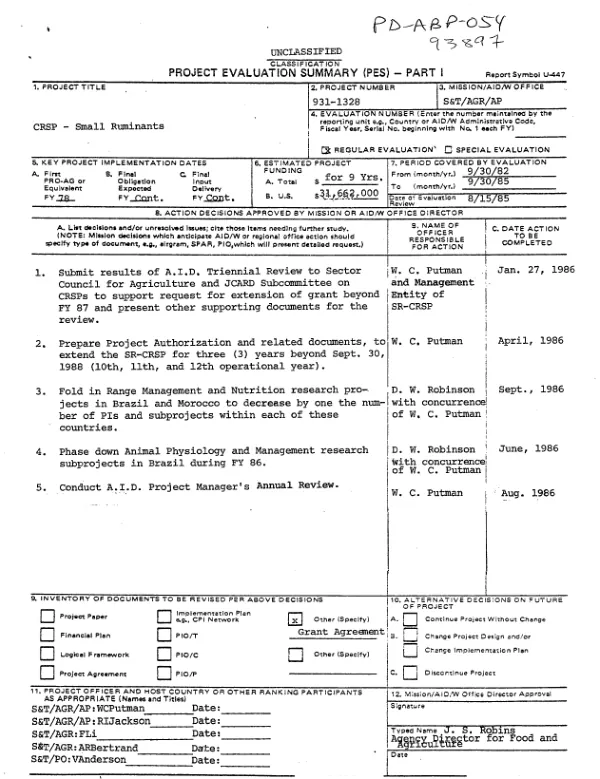
Summarizes evaluation (unattached) of a project to promote collaborative research on small ruminant production (SR-CRSP program).
1985
Sign in to readA free account is required to download.
Abstract
Interim evaluation covers the period 9/30/82-9/30/85. The SR-CRSP established Memoranda of Understanding with all five of the original target countries, where work is now underway: Indonesia, Kenya, Morocco, Brazil and Peru. Excellent relationships have been established with the administrators and scientists in each host country. Most of the Missions are showing a keener interest in program activities and a couple of them have helped to strengthen in-country programs. SR-CRSP resources, used as seed money, have inspired substantial investment from local governments with the result that many lasting facilities are now in place. Training has been extremely successful; 85 scientists from developing countries have received or are currently earning graduate degrees in U.S. institutions, and 20 U.S. graduate students have received long-term training in host countries. The program has supported 40 students during Masters work in host country universities/ colleges, and 25 students in host countries in Bachelors work. An encouraging percentage of females in both U.S. and host country long-term degree programs have received support. In addition, the program has sent 8 overseas counterpart researchers to the United States for short-term intensive instruction on advanced research techniques, and provided many of the U.S. scientists with specialized training in research methodology and facility development during overseas TDYs. SR-CRSP scientists have participated in and/or sponsored 16 short courses in host countries which have attracted from 10 to 117 attendees. Perhaps most significantly, the SR-CRSP has focused on the needs of the smallholder or limited resource farmer. In Indonesia and Kenya, all resources have been used to conduct baseline surveys at the village level in every discipline. In Peru, work has been concentrated in the Central and Southern High Sierra on cooperatives formed after land reform or with ethnic groups in isolated villages. In Brazil, the SR-CRSP has complemented the Brazilian Agricultural Research Corporation"s (EMBRAPA) Sheep and Goat Research Center, which was inaugurated in 1978, while in Morocco, the SR-CRSP has established new animal research facilities with Hassan II University. SR-CRSP scientists have disseminated their findings in over 1,200 research reports, papers, abstracts, and verbal presentations related to small ruminants; and through symposia, seminars, and short courses. U.S. scientists have achieved direct "hands on" experience with the world"s most prolific breeds of sheep (all of which exist outside the United States). The SR-CRSP has been instrumental in the detection and elimination of a goat virus (CAE) in one country, saving that country approximately $2 million in animal losses per year, as well as in developing a heat stable vaccine for contagious caprine pleuropneumonia (CCPP), which is expected to result in $15 million savings per year. With the introduction of improved management practices, all host countries are experiencing increases in sheep and goat production. In sum, the CRSP, which is directed at the small producer in developing countries, is showing excellent progress and a potential for achieving far-reaching repercussions for U.S. industry. The primary lesson learned is that a uniform management procedure, while easier to implement, is not effective for a CRSP program, which operates within many and varied country contexts. Accordingly, management procedures should vary.
Related documents