USAID. BUR. FOR SCIENCE AND TECHNOLOGY. OFC. OF AGRICULTURE
Small ruminants CRSP
Evaluates project to link U.S., international, and LDC agricultural institutions in order to organize research programs in small ruminant production.
Haines, C. E.; Warren, P. · 1983
Sign in to readA free account is required to download.
Abstract
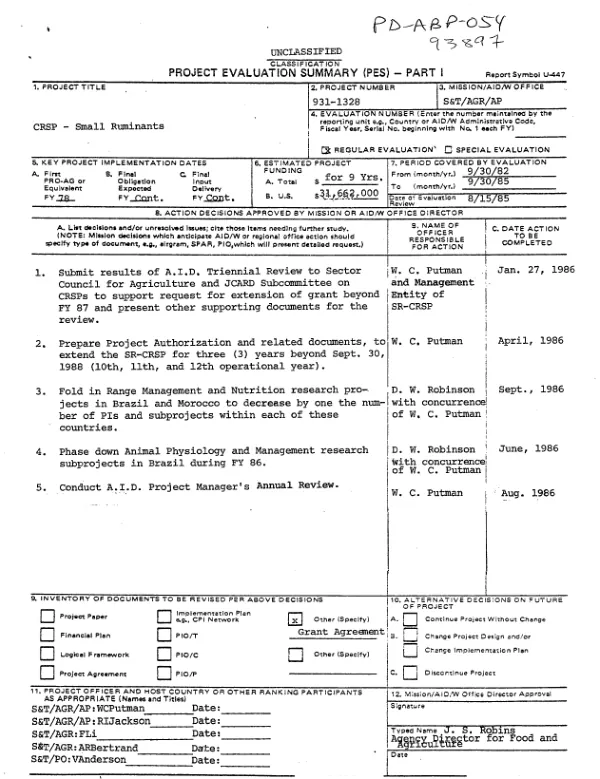
Special PES covers the period 10/1/79-9/30/82 and is based on document review, interviews with project participants, and visits to participating universities and the Management Entity at the University of California-Davis (UC/D). The Small Ruminant Collaborative Research Support Program (SR-CRSP) consists of 7 subprojects in sheep and goat husbandry: male reproductive physiology at California State Poly (carried out in Brazil and Peru); female reproductive physiology and rangelands at Utah State (Brazil and Peru); animal health and breeding at UC/D (Brazil, Kenya, Indonesia); animal health at Washington State (Kenya); and animal breeding at Montana State (Peru, Colombia). All subprojects focus on small farmer needs. Research is of high quality and has proceeded in an expeditious manner. In several instances, CRSP activities have served as a catalyst, generating substantial host-country research investments. Extension of findings through field days and short courses is underway. CRSP research in Kenya has focused attention on Caprine Arthritis Encephalitis and efforts to control this virus. Strong linkages have been developed among LDC and U.S. institutions, scientists, and administrators. CRSP activities have also resulted in over 40 papers presented both in the United States and overseas at symposia, seminars and short courses, 6 papers at major scientifc meetings, and 5 papers submitted to scientific journals; 26 internal publications were also produced. The potential benefits of the CRSP to the U.S. sheep and goat industries are enormous. The project has materially changed U.S. teaching and research, spawning new courses, improved facilities, and campus-wide interest in small ruminant husbandry. An excellent training program is underway; 9 Ph.D and 26 M.S. students have been trained in the United States, and 20 M.S. and 15 B.S. students in home country programs. U.S. students, including 8 Ph.D."s, have collected data overseas. Among the action decisions are to extend the project one year and prepare documentation for a three-year extension.
Related documents