USAID DEC
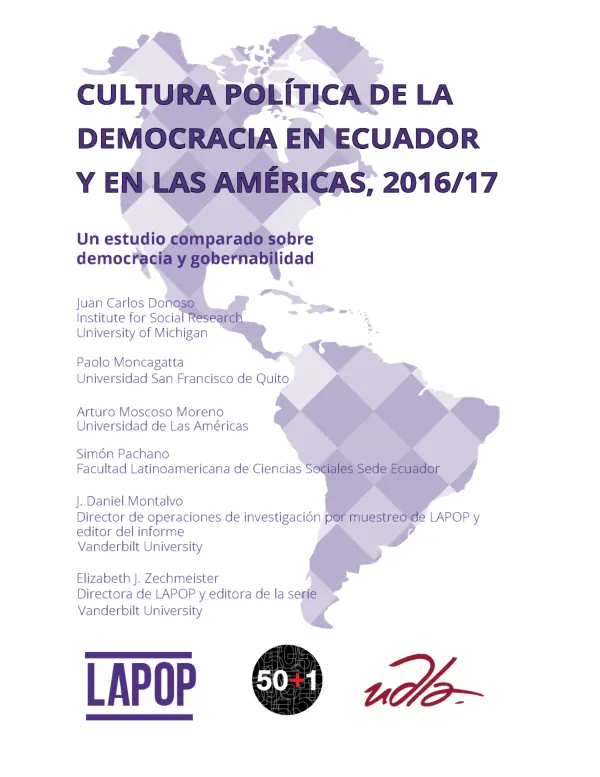
Cultura política de la democracia en Ecuador y en las Américas, 2016/17: Un estudio comparado sobre democracia y gobernabilidad
Sign inLAPOP
Cultura política de la democracia en Ecuador y en las Américas, 2016/17: Un estudio comparado sobre democracia y gobernabilidad
The study "Cultura política de la democracia en Ecuador y en las Américas, 2016/17: Un estudio comparado sobre democracia y gobernabilidad" was conducted by a team of researchers from the University of Michigan and the Universidad San Francisco de Quito, among others.
2018 · 229 pages
Sign in to readA free account is required to download.
Abstract
The study aimed to examine the political culture of democracy in Ecuador and the Americas, with a focus on the relationship between democracy, governance, and citizen attitudes. The study's findings suggest that the level of support for democracy in Ecuador is relatively high, with 64% of respondents expressing approval for the democratic system. However, the study also notes that there are significant concerns about corruption, with 71% of respondents reporting that corruption is a major problem in the country. The study also finds that citizens' perceptions of corruption are closely tied to their attitudes towards democracy, with those who perceive corruption as a major problem being less likely to support democracy. The study also examines the relationship between democracy and governance in Ecuador, finding that the country's democratic institutions are relatively weak. The study notes that the government's handling of the economy and the provision of public services are major concerns for citizens, and that there is a lack of trust in the government's ability to address these issues. In terms of citizen attitudes towards democracy, the study finds that there is a strong sense of national identity and a desire for a more participatory and inclusive form of democracy. The study also notes that there are significant differences in attitudes towards democracy between different segments of the population, with younger and more educated citizens being more likely to support democracy. The study's findings have implications for the development of democratic institutions and policies in Ecuador and the Americas. The study suggests that addressing corruption and improving the provision of public services are critical for building trust in democratic institutions and promoting citizen participation. The study also highlights the need for more inclusive and participatory forms of democracy that take into account the diverse needs and perspectives of citizens. The study's methodology involved a survey of over 1,000 citizens in Ecuador, as well as a comparison with data from other countries in the Americas. The study's findings are based on a range of indicators, including citizen attitudes towards democracy, governance, and corruption, as well as measures of democratic institutions and policies. Overall, the study provides a nuanced and detailed analysis of the political culture of democracy in Ecuador and the Americas, highlighting the complex relationships between democracy, governance, and citizen attitudes. The study's findings have important implications for the development of democratic institutions and policies in the region, and highlight the need for more inclusive and participatory forms of democracy that take into account the diverse needs and perspectives of citizens. The study's findings on corruption and democracy in Ecuador are particularly noteworthy, highlighting the need for more effective measures to address corruption and promote transparency and accountability in government. The study also notes that the government's handling of the economy and the provision of public services are major concerns for citizens, and that there is a lack of trust in the government's ability to address these issues. In terms of policy recommendations, the study suggests that addressing corruption and improving the provision of public services are critical for building trust in democratic institutions and promoting citizen participation. The study also highlights the need for more inclusive and participatory forms of democracy that take into account the diverse needs and perspectives of citizens. The study's findings on the relationship between democracy and governance in Ecuador are also significant, highlighting the need for more effective measures to promote democratic governance and address the challenges facing the country. The study notes that the government's handling of the economy and the provision of public services are major concerns for citizens, and that there is a lack of trust in the government's ability to address these issues.
Related documents