USAID DEC
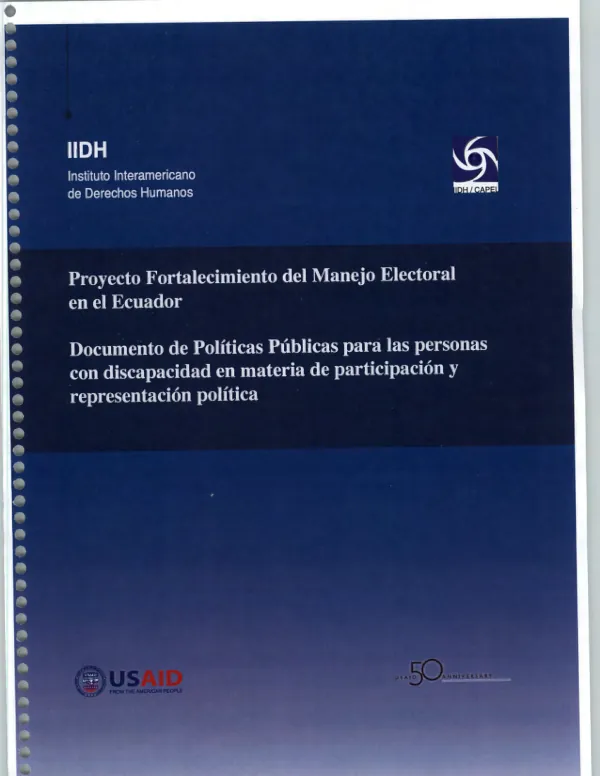
Documentos de Políticas Públicas para las Personas con Discapacidad en Materia de Participación y Representación Política
Sign inAGENCIA DE LOS ESTADOS UNIDOS PARA EL DESARROLLO INTERNACIONAL
Documentos de Políticas Públicas para las Personas con Discapacidad en Materia de Participación y Representación Política
The Ecuadorian State's constitutional framework has established various norms related to the formulation, execution, evaluation, and control of public policies, including those concerning the rights of persons with disabilities.
2011 · 16 pages
Sign in to readA free account is required to download.
Abstract
Article 85 of the Constitution outlines the principles guiding public policy formulation, emphasizing the importance of solidarity and the protection of constitutional rights. The State is obligated to ensure the effective enjoyment of rights, including those of persons with disabilities, without discrimination. The Constitution's Article 1 defines the Ecuadorian State as a constitutional democracy, social, sovereign, independent, unitary, intercultural, plurinational, and secular entity. This definition implies essential obligations regarding the guarantee of participation and political representation of persons with disabilities. Article 3 of the Constitution, in its numerals 1, 5, and 8, obliges the State to ensure the effective enjoyment of rights, including those of persons with disabilities, and to promote their development and access to the "buen vivir" (good living). The Constitution also establishes the principle of participation and representation of persons with disabilities, as stated in Article 48, numerals 4 and 7. The State is obligated to adopt measures to ensure the inclusion of persons with disabilities in social, cultural, educational, and economic activities, as well as their participation in political life, ensuring their representation in accordance with the law. The Ecuadorian State's Constitution and international human rights instruments, such as the Convention on the Rights of Persons with Disabilities and its Optional Protocol, provide a framework for the formulation of public policies aimed at promoting the rights of persons with disabilities. The Constitution's Article 35 emphasizes the need for special protection and attention to persons with disabilities, who are considered a priority group. The Ecuadorian State's Constitution and laws establish various measures to promote the inclusion and participation of persons with disabilities, including the adoption of policies to prevent disabilities, promote social integration, and ensure equal opportunities. The Constitution also recognizes the rights of persons with disabilities to health, rehabilitation, employment, housing, education, and access to goods and services. To promote the participation and representation of persons with disabilities, it is essential to educate citizens about their rights and to ensure that electoral precincts are accessible to persons with disabilities. The Constitution's Article 61 emphasizes the need for civic education and democratic values to promote the full and effective exercise of the rights of persons with disabilities. The Ecuadorian State's Constitution and laws establish a framework for the promotion of the rights of persons with disabilities, including their participation and representation in political life. The State's obligations to ensure the effective enjoyment of rights, including those of persons with disabilities, are essential for promoting their inclusion and participation in society.
Related documents