CHECCHI AND COMPANY, CONSULTING, INC.
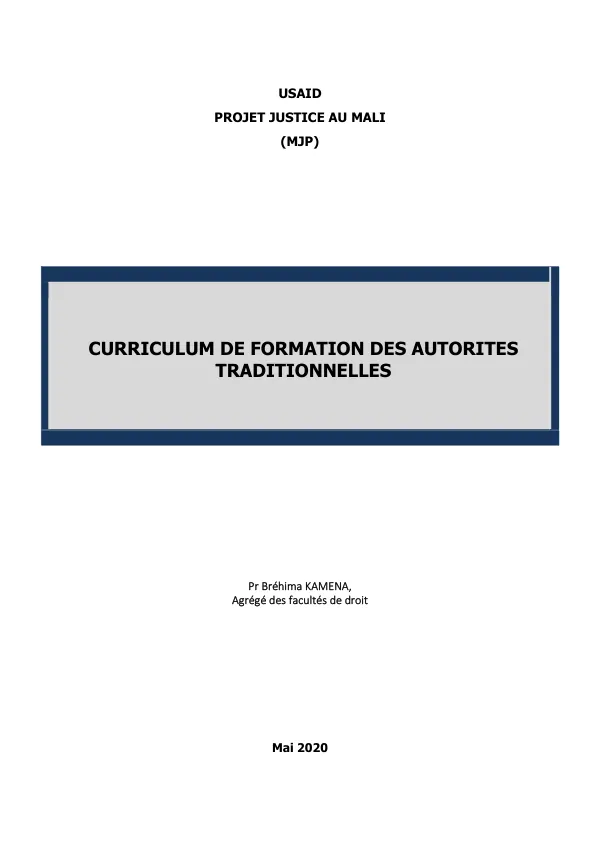
Curriculum de Formation des Autorités Traditionnelles
The Projet Justice au Mali (MJP) is a development initiative funded by the United States Agency for International Development (USAID) and implemented by Checchi and Company Consulting.
2020 · 98 pages
Sign in to readA free account is required to download.
Abstract
The project aims to improve the efficiency, effectiveness, and capacity of the Malian judicial institutions. To achieve this goal, the MJP collaborates with both the formal and informal sectors of the justice system, focusing on strengthening the institutional capacities of key justice institutions, improving access to justice, and providing targeted legal services, advocacy campaigns, and public information. The project works closely with the Section des Affaires Judiciaires et Pénitentiaires (SAJP) of the MINUSMA, the Ministry of Territorial Administration and Decentralization, and the Ministry of Justice and Human Rights through the Direction Nationale des Affaires Judiciaires et du Sceau (DNAJS). The MJP's objectives are aligned with the Malian government's goal of harmonizing traditional justice with state justice, increasing access to justice for the Malian population, and promoting social peace in the country. The international community has emphasized the need to reconcile state justice and traditional justice, as well as to address and resolve conflicts that have led to human rights violations. Additionally, scholars and practitioners recognize that justice cannot be reduced solely to modern law, but must also include customary or traditional law. The Accords for Peace and Reconciliation in Mali include a commitment to implement a comprehensive reform of the justice system, bringing it closer to the citizen, improving its performance, and integrating traditional and customary devices without prejudice to the state's regulatory power. The MJP's curriculum on the formation of traditional authorities is designed to support the development of a more effective and efficient justice system in Mali. The curriculum focuses on the organization of the Malian judicial system, modes of alternative dispute resolution, guarantees of equitable justice, the status of traditional authorities, and the details of their attributions. The curriculum is structured into eight modules, each addressing a specific aspect of the justice system in Mali. Module I provides an overview of the Malian judicial system, including the courts, administrative jurisdictions, and other key institutions. Module II explores modes of alternative dispute resolution, including arbitration, mediation, and conciliation. Module III examines the guarantees of equitable justice, including the principles of civil and penal procedures. Module IV focuses on the status of traditional authorities, including their designation, attributions, rights, and disciplinary sanctions. Module V provides a detailed overview of the attributions of traditional authorities, including administration, land tenure, marriage, succession, and civil and customary affairs. Module VI addresses the characteristics of an effective team and the qualities of a successful leader. Module VII explores the cartography of community resources, including definitions, levels of community resources, and the process of mapping resources. Module VIII examines interpersonal communication, including non-verbal communication, its interest, and types. The MJP's curriculum is designed to support the development of a more effective and efficient justice system in Mali, one that is responsive to the needs of the Malian population and promotes social peace in the country.
Related documents