USAID DEC
MANUEL DE PROCEDURE PLATFORME: Cellules de Veille pour la Lutte contre la Corruption et les Tracasseries sur les Corridors Routiers du Mali
Sign inUSAID
MANUEL DE PROCEDURE PLATFORME: Cellules de Veille pour la Lutte contre la Corruption et les Tracasseries sur les Corridors Routiers du Mali
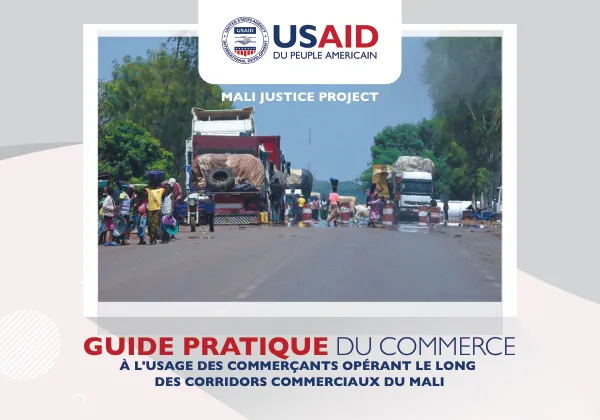
The Mali Justice Project, a collaborative effort between the Plateforme Inter Régionale sur la libre circulation des personnes et des biens and its partners, has been actively working since 2016 to combat corruption and harassment along the corridors of the Sikasso region in Mali.
2020 · 36 pages
Sign in to readA free account is required to download.
Abstract
The project's primary objective is to promote integrity in the control system of the corridors and to reduce corruption in all its forms. To achieve this goal, the project has established five cellules de veille, which are now under the responsibility of the local branches. These cellules de veille are composed of members who have accumulated significant experience and expertise in assisting users of the corridors who are victims of various abuses perpetrated by agents of control. The members of the cellules de veille have been able to inform and sensitize a large number of citizens and economic operators in the region about their rights and obligations in matters of transportation and cross-border trade. The cellules de veille have also encountered resistance from certain agents of control who are frustrated by their interventions. Despite this, the members of the cellules de veille have remained determined to promote the integrity of the control system and to combat corruption in all its forms. They have found new approaches and techniques to improve their interventions and to achieve greater efficiency and sustainability. The present manual of procedures is the result of this search for excellence in citizen vigilance of the corridors of Mali. It will be shared with all members of the cellules de veille and the Plateforme Inter Régionale to enable them to constantly evolve towards a professionalism and ethical competence in their actions. The manual is also available to all activists and agents of change working in the concerned themes. The mission of the cellules de veille is to cooperate with all stakeholders to conduct a permanent citizen vigilance of the practices and behaviors at the control and security posts on the corridors. They are responsible for informing and sensitizing the stakeholders (drivers, traders, transporters, and travelers) on the fight against corruption and harassment, their rights in matters of circulation and transaction on the corridors, and the necessity of formalization and professional obligations. The cellules de veille are also responsible for documenting abuses and cases of corruption or practices assimilated to the control posts, assisting victims of abuses, corruption, or practices assimilated to the control posts in their interactions with the control agents, contributing to the resolution of problems of application of the law between control agents and road users, collecting data on corruption and harassment, and informing the Plateforme (Bureau Exécutif of the local branch and the Coordination of the PIR) regularly. The cellules de veille are composed of four members, including a Chef de Cellule, two Facilitateurs, and one Para-juriste. However, each local branch can increase the number of Facilitateurs or Para-juristes according to its needs. The Chef de Cellule is responsible for the good functioning of the operations of citizen vigilance on the control and security points of the corridor road. He is responsible for planning and coordinating the activities of the cellule de veille, following up on the activities of vigilance on the corridors, and remitting information to the local branch. The cellules de veille are operational structures of the local branch responsible for ensuring the missions defined above. The Bureau Exécutif of the local branch is responsible for setting up its cellule de veille, describing the profile of its members, and recruiting them. The Bureau Exécutif also ensures the operationality of the cellule de veille by providing training, technical support, equipment, and tools for work, paying indemnities, and other necessary resources.