USAID DEC
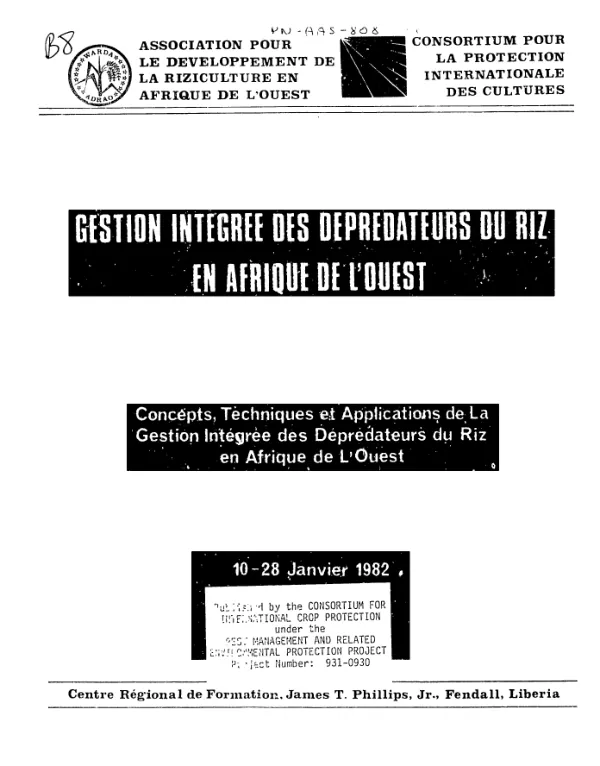
Concepts, techniques et applications de la gestion intégrée des déprédateurs du riz en Afrique de l'Ouest
Sign inUSAID
Concepts, techniques et applications de la gestion intégrée des déprédateurs du riz en Afrique de l'Ouest
The agricultural development initiative in West Africa began in the 1970s with a focus on crop protection.
537 pages
Sign in to readA free account is required to download.
Abstract
The Association for the Development of Rice Culture in West Africa (ADRAO) and the Centre Regional de Formation James T. Phillips, Jr. in Fendall, Liberia, partnered with the Consortium for International Crop Protection (CICP) and the United States Agency for International Development (USAID) to address the challenges of rice cultivation in the region. The main objective of the initiative was to familiarize participants with the concepts, techniques, and applications of integrated pest management (IPM) for rice cultivation in West Africa. The specific objectives included exposing participants to the concepts and techniques of IPM, discussing the problems caused by pests affecting rice cultivation in the region, and establishing mechanisms for dialogue and effective coordination among specialists in rice protection and IPM. The initiative involved a training program for 28 participants from 13 countries in West Africa, including Ghana, Guinea, Guinea-Bissau, Ivory Coast, Mali, Niger, Senegal, Sierra Leone, and Togo. The program included a review of the problems caused by pests affecting rice cultivation, a visit to the Institut Contral de Recherche Agricole de Suakoko, and a group discussion on the topic of pest control. The participants were divided into groups to prepare and present a report on the needs for further training in IPM for rice cultivation in West Africa. The report highlighted the importance of integrated pest management in rice cultivation, including the use of biological, cultural, and physical methods to control pests. The report also emphasized the need for a comprehensive approach to pest management, including the use of resistant varieties, crop rotation, and biological control. The initiative was a significant step towards developing a comprehensive approach to pest management in rice cultivation in West Africa. The report concluded that the use of integrated pest management techniques could help to reduce the use of chemical pesticides and improve crop yields. The initiative also highlighted the need for further research and training in IPM for rice cultivation in the region. The concept of integrated pest management has been around for thousands of years, with ancient civilizations using various methods to control pests. The use of biological, cultural, and physical methods to control pests has been documented in ancient texts, including the use of sulfur compounds to control insects and mites. The use of plant-based insecticides has also been documented in ancient China, where farmers used plant extracts to control pests. In recent years, the use of integrated pest management has become increasingly important in agriculture, as the overuse of chemical pesticides has led to the development of pesticide-resistant pests and environmental pollution. The use of integrated pest management techniques, including the use of resistant varieties, crop rotation, and biological control, has been shown to be effective in reducing pest populations and improving crop yields. The initiative in West Africa was a significant step towards developing a comprehensive approach to pest management in rice cultivation in the region. The report highlighted the importance of integrated pest management in rice cultivation, including the use of biological, cultural, and physical methods to control pests. The report also emphasized the need for further research and training in IPM for rice cultivation in the region. The use of integrated pest management techniques has been shown to be effective in reducing pest populations and improving crop yields. The initiative in West Africa was a significant step towards developing a comprehensive approach to pest management in rice cultivation in the region. The report highlighted the importance of integrated pest management in rice cultivation, including the use of biological, cultural, and physical methods to control pests. The initiative was a collaborative effort between the ADRAO, the CICP, and the USAID, with the goal of developing a comprehensive approach to pest management in rice cultivation in West Africa. The report concluded that the use of integrated pest management techniques could help to reduce the use of chemical pesticides and improve crop yields. The initiative also highlighted the need for further research and training in IPM for rice cultivation in the region.
Related documents
Documents in this collection
 2014
2014USAID DEC
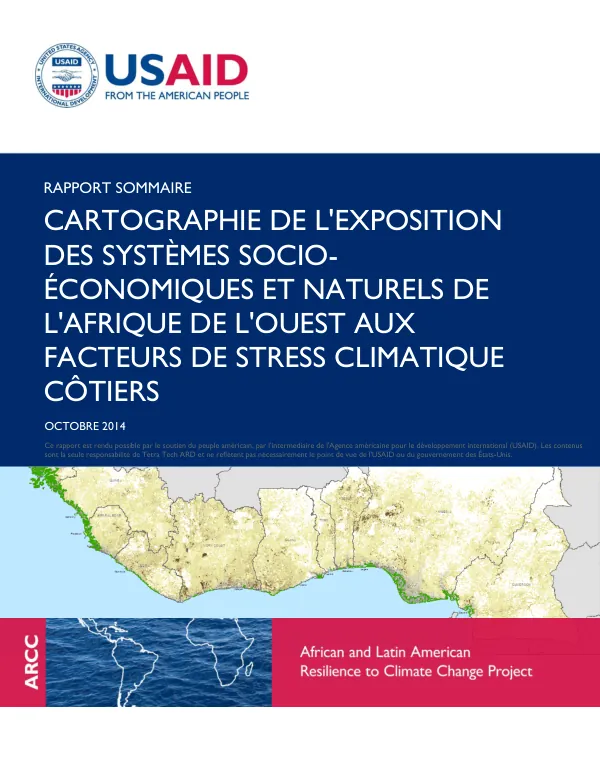
Cartographie de l'exposition des systèmes socio-économiques et naturels de l'Afrique de l'Ouest aux facteurs de stress climatique côtiers
Open record 2014
2014USAID DEC