USAID DEC
Cytotoxicity Effects of Amoora rohituka and chittagonga on Breast and Pancreatic Cancer Cells
Sign inUNIVERSITY OF ILLINOIS, URBANA-CHAMPAIGN
Cytotoxicity Effects of Amoora rohituka and chittagonga on Breast and Pancreatic Cancer Cells
Cancer is a leading cause of death in the United States, resulting from the uncontrollable division of abnormal cells.
2011 · 9 pages
Sign in to readA free account is required to download.
Abstract
Breast cancer is one of the most common cancers worldwide, with a high mortality rate if diagnosed in the later stages. Pancreatic cancer has a high mortality rate and often cannot be detected at an early stage due to the fact that symptoms do not appear until the disease has advanced significantly. Typical treatment regimes include targeting the tumor with ionizing radiation, surgical removal of tumor tissue, and chemotherapy. However, these current cancer treatment methods also cause severe systemic side effects. Recent research has focused on the search for alternative medicines extracted from plant-based sources. The use of alternative medicines, especially when used in conjunction with conventional cancer treatments, can serve to mitigate the side effects, enhance the uptake of conventional medicines, and bolster the immune system to fight the cancer. Since these medicines are primarily extracts of naturally occurring flora, their bioavailability is less likely to induce severe immune responses. Several species of the Amoora plant extract in many parts of Bangladesh possess a multitude of medicinal properties against inflammation, cancer, and diseases of the liver. The Amoora rohituka is an evergreen tree that grows wildly in the region and is planted in many districts of Bangladesh. It is traditionally used as herbal medicine for cancer, tumor, liver, and spleen diseases. The petroleum ether and methanol extracts of Amoora rohituka are reported to possess good laxative potential and can be developed to perform as safer gastrointestinal agents. Furthermore, Amoora rohituka extracts are also known to possess antimicrobial activity. The plant triterpenic acid, amooranin, extracted from the bark of Amoora rohituka trees, has been reported to possess significant anticancer potential. The Amoora chittagonga was fractionated with pet-ether (petroleum ether), CH2Cl2 (dichloromethane), and EtoAC (ethanol), while Amoora rohituka was fractionated with pet-ether and MeOH (methanol). Utilizing a conventional MTT assay, the five extracts were tested on each cell line at four concentrations ranging from 100 µg/mL to 0.1 µg/mL and the IC50 values were determined. The results of the MTT assay were then confirmed using a label-free photonic crystal (PC) biosensor assay. The PC biosensor provides an image of the attachment of cells on the sensor surface before and after the incubation with plant extracts, which can determine the cytotoxicity effects. The cytotoxicity of each extract was analyzed using the MTT assay and label-free photonic crystal biosensor assay. A concentration series of each extract was performed on the six cell lines. For MCF-7 cancer cells, the chittagonga (Pet-Ether and CH2Cl2) and rohituka (Pet-Ether) extracts induced cytotoxicity; the chittagonga (EtoAC) and rohituka (MeOH) extracts did not induce cytotoxicity. For HTB126, Panc-1, Mia-Paca2, and Capan-1 cancer cells, only the chittagonga CH2Cl2 extract showed a significant cytotoxic effect. The extracts were not cytotoxic to normal fibroblast Hs68 cells, which may be correlated to the specificity of Amoora extracts in targeting cancerous cells.
Related documents
Documents in this collection
 2019
2019USAID DEC
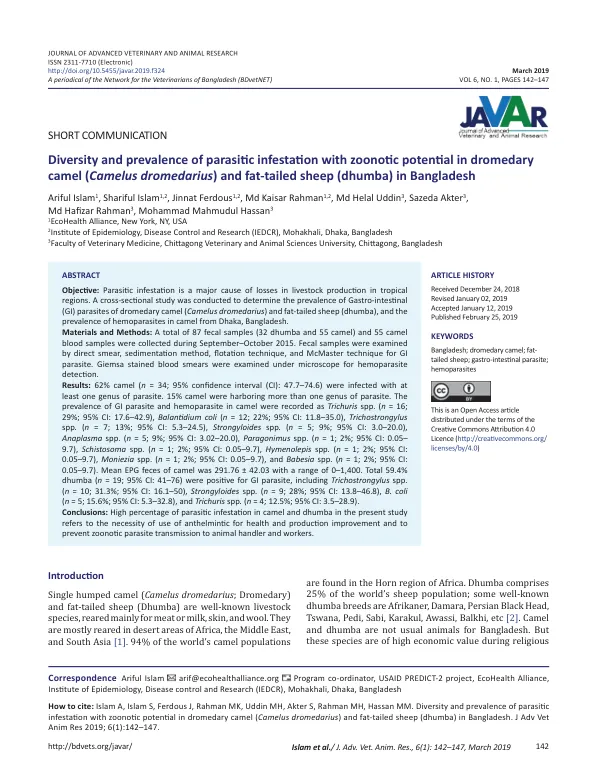
Diversity and prevalence of parasitic infestation with zoonotic potential in dromedary camel (Camelus dromedarius) and fat-tailed sheep (dhumba) in Bangladesh
Open record 2017
2017USAID DEC