UNIVERSITY OF CAPE TOWN
DaRifi Trial Landscape
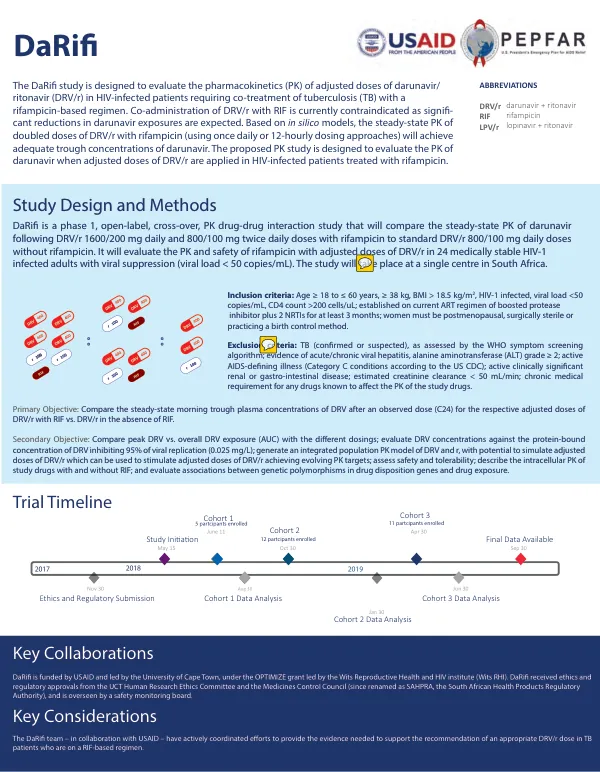
The DaRifi study is designed to evaluate the pharmacokinetics (PK) of adjusted doses of darunavir/ritonavir (DRV/r) in HIV-infected patients requiring co-treatment of tuberculosis (TB) with a rifampicin-based regimen.
2018 · 2 pages
Sign in to readA free account is required to download.
Abstract
The study aims to compare the steady-state morning trough plasma concentrations of DRV after an observed dose (C24) for the respective adjusted doses of DRV/r with RIF versus DRV/r in the absence of RIF. This comparison will be made in 24 medically stable HIV-1 infected adults with viral suppression (viral load < 50 copies/mL). The study will evaluate the PK and safety of rifampicin with adjusted doses of DRV/r. Participants will be enrolled in a phase 1, open-label, cross-over, PK drug-drug interaction study. The study will take place at a single centre in South Africa and will involve the administration of DRV/r 1600/200 mg daily and 800/100 mg twice daily doses with rifampicin, as well as standard DRV/r 800/100 mg daily doses without rifampicin. The study will assess the PK and safety of rifampicin with adjusted doses of DRV/r in HIV-infected patients treated with rifampicin. The study will also evaluate the associations between genetic polymorphisms in drug disposition genes and drug exposure. The study will be conducted in accordance with the principles of Good Clinical Practice and will be overseen by a safety monitoring board. The study has received ethics and regulatory approvals from the UCT Human Research Ethics Committee and the Medicines Control Council (since renamed as SAHPRA, the South African Health Products Regulatory Authority). The study is funded by USAID and led by the University of Cape Town, under the OPTIMIZE grant led by the Wits Reproductive Health and HIV institute (Wits RHI). The study will involve the administration of DRV/r 1600/200 mg daily and 800/100 mg twice daily doses with rifampicin, as well as standard DRV/r 800/100 mg daily doses without rifampicin. The study will assess the PK and safety of rifampicin with adjusted doses of DRV/r in HIV-infected patients treated with rifampicin. The study will also evaluate the associations between genetic polymorphisms in drug disposition genes and drug exposure. The study will take place over a period of approximately 2 years, with enrollment of participants beginning in May 2017 and completion of the study in September 2019. The study will involve the administration of DRV/r 1600/200 mg daily and 800/100 mg twice daily doses with rifampicin, as well as standard DRV/r 800/100 mg daily doses without rifampicin. The study will assess the PK and safety of rifampicin with adjusted doses of DRV/r in HIV-infected patients treated with rifampicin.