USAID DEC
One size does not fit all: reaching agricultural workers in South Africa with TB services
Sign inUNIVERSITY RESEARCH CORPORATION CO., LLC
One size does not fit all: reaching agricultural workers in South Africa with TB services
TB incidence has decreased steadily in South Africa, from 834 per 100,000 population in 2015 to 615/100,000 in 2019.
2021 · 7 pages
Sign in to readA free account is required to download.
Abstract
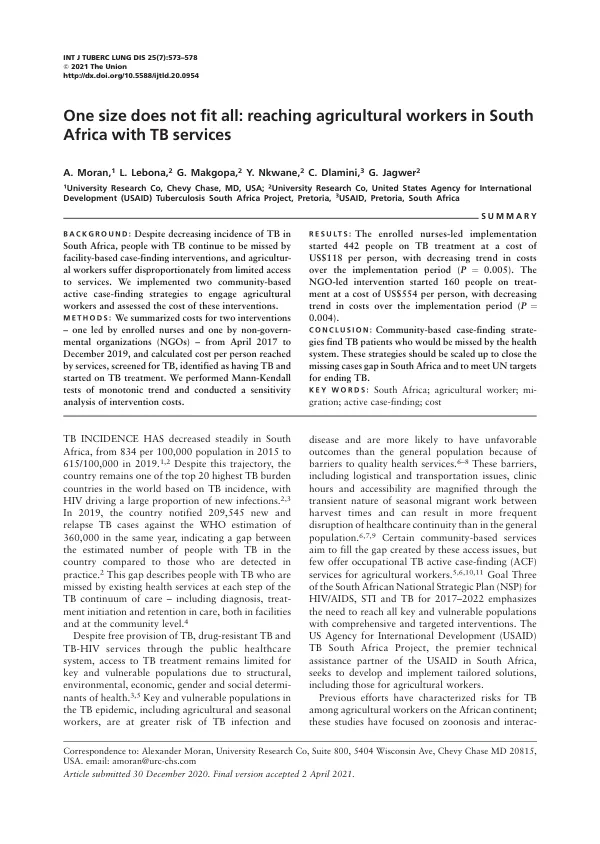
Despite this trajectory, the country remains one of the top 20 highest TB burden countries in the world based on TB incidence, with HIV driving a large proportion of new infections. In 2019, the country notified 209,545 new and relapse TB cases against the WHO estimation of 360,000 in the same year, indicating a gap between the estimated number of people with TB in the country compared to those who are detected in practice. This gap describes people with TB who are missed by existing health services at each step of the TB continuum of care – including diagnosis, treatment initiation and retention in care, both in facilities and at the community level. Agricultural workers in South Africa suffer disproportionately from limited access to TB services due to structural, environmental, economic, gender and social determinants of health. These barriers, including logistical and transportation issues, clinic hours and accessibility, are magnified through the transient nature of seasonal migrant work between harvest times and can result in more frequent disruption of healthcare continuity than in the general population. Certain community-based services aim to fill the gap created by these access issues, but few offer occupational TB active case-finding (ACF) services for agricultural workers. Goal Three of the South African National Strategic Plan (NSP) for HIV/AIDS, STI and TB for 2017–2022 emphasizes the need to reach all key and vulnerable populations with comprehensive and targeted interventions. The US Agency for International Development (USAID) TB South Africa Project seeks to develop and implement tailored solutions, including those for agricultural workers. Previous efforts have characterized risks for TB among agricultural workers on the African continent; these studies have focused on zoonosis and interactions with livestock, rather than occupational risk factors. Our study assessed the reach of two targeted ACF interventions for agricultural workers in the Eastern Cape and Western Cape provinces of South Africa and documented the cost of these interventions. We hypothesized that these interventions helped find people with TB who would have otherwise been missed by the health system and that these ACF strategies meet published cost-effectiveness thresholds. We assessed the availability of TB health services for farm workers and identified gaps in access to existing services from a health payer perspective. South Africa has comprehensive TB services, including diagnostic, treatment, adherence and social support services, offered in public health facilities and through community-based teams called Ward-Based Outreach Teams (WBOTs). We developed a differentiated model of care based on this assessment to focus on three areas in the community: community engagement, capacity building and improved access to TB and other health services. This model was implemented through two mechanisms: a cadre of contracted nurses as part of existing key populations programming and an existing non-governmental organization (NGO) support strategy implemented by the USAID TB South Africa Project. The enrolled nurses-led implementation started 442 people on TB treatment at a cost of US$118 per person, with a decreasing trend in costs over the implementation period. The NGO-led implementation started 160 people on treatment at a cost of US$554 per person, with a decreasing trend in costs over the implementation period. Community-based case-finding strategies find TB patients who would be missed by the health system. These strategies should be scaled up to close the missing cases gap in South Africa and to meet UN targets for ending TB.