USAID. BUR. FOR SCIENCE AND TECHNOLOGY. OFC. OF HEALTH
Data for decision-making
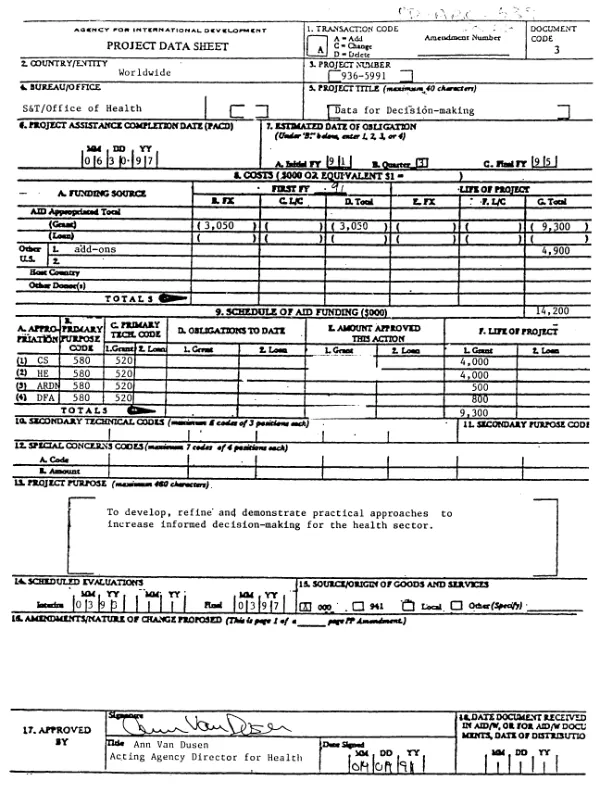
Project to develop and demonstrate practical ways to increase informed decisionmaking by the health sector.
1991
Sign in to readA free account is required to download.
Abstract
The project will: (1) identify and test various data analysis tools; (2) build local decisionmaking capacity; and (3) establish a mechanism to advise donors on epidemiologic and demographic trends. A variety of data analysis and dissemination tools, ranging from computer analyses and electronic mail to newsletters and conferences, will be identified and evaluated for their effectiveness in presenting health data to various levels of decisionmakers. A small sub-grants program will support the testing/refinement of the tools at the country level. Each tool will be tested in at least 2 countries. All in all, 16-20 tools will be tested, of which approximately 8 will be approved for future extension. For each tool tested, an information package will be prepared describing its strengths and weaknesses and the testing methodology used. Also, a case study will be approved for most of the tools. A long-term (24-30 month) program to strengthen decisionmaking will be undertaken in 3-4 countries. Each program will include: a health information inventory and assessment of the types of information being collected and disseminated on priority health issues; and a decisionmaking activity plan based on the results of the inventory and assessment. Each activity plan will be country-specific and will include details on proposed data analysis tools, training and TA objectives, institutional arrangements, etc. In India, the Rockefeller Foundation is expected to participate in an effort to incorporate data for decisionmaking tools into the public health curricula of medical schools. Besides the long-term programs, the project will undertake smaller, problem-specific activities to improve data collection or to increase community participation in decisionmaking. Finally, the project will support a mechanism to advise A.I.D., other donors, and host countries on changing demographic and epidemiologic trends. The mechanism will consist of panels of experts and working groups, which will discuss existing documentation on various subjects, commission technical papers, and recommend specific policies. The panels and working groups will focus on 2 A.I.D. priorities: sustaining child survival program initiatives and responding to emerging health problems. The Centers for Disease Control and other pertinent institutions will participate. The project will disseminate its results through a variety of channels, e.g., existing international networks, case studies, linkages with training programs, and cooperation with other A.I.D.-funded projects.