USAID DEC
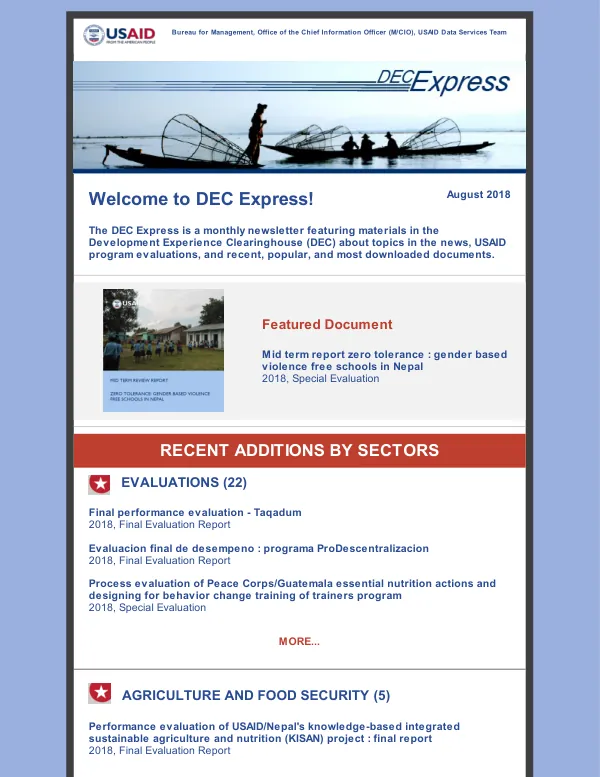
DEC Express August 2018
The Development Experience Clearinghouse (DEC) is a repository of knowledge and information on USAID's development programs and projects.
2018 · 5 pages
Sign in to readA free account is required to download.
Abstract
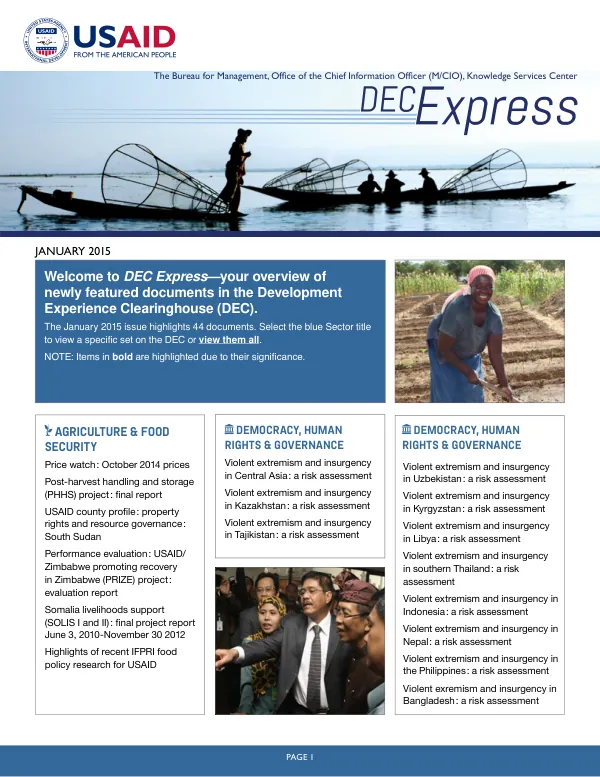
The DEC Express is a monthly newsletter that highlights recent additions to the DEC, including evaluations, reports, and other documents. The August 2018 edition of the DEC Express features a special evaluation report on zero tolerance for gender-based violence in schools in Nepal. The report, conducted in 2018, focuses on the implementation of a zero-tolerance policy for gender-based violence in schools in Nepal. The evaluation assesses the effectiveness of the policy in reducing violence and promoting a safe learning environment for students. The report highlights the importance of addressing gender-based violence in schools and provides recommendations for improving the policy's implementation. In addition to the featured report, the DEC Express highlights recent additions to the DEC by sector. The agriculture and food security sector features a performance evaluation of the knowledge-based integrated sustainable agriculture and nutrition (KISAN) project in Nepal, which found that the project improved crop yields and increased farmers' income. The report also highlights a stakeholder analysis of integrated activities in the agriculture sector in Malawi, which identified key challenges and opportunities for improving agricultural development in the country. The democracy, human rights, and governance sector features an assessment report on civil society organizations in Indonesia, which found that the organizations played a critical role in promoting democracy and human rights in the country. The report also highlights a final performance evaluation of the Taqadum project, which found that the project improved the capacity of local governments to deliver services to citizens. The economic growth and trade sector features an impact evaluation of the women's leadership in small and medium enterprises activity in the Kyrgyz Republic, which found that the activity improved women's economic empowerment and increased their participation in the economy. The report also highlights a final report on the Volunteers for Economic Growth Alliance Leader with Associate Award (VEGA LWA), which found that the program improved the capacity of local organizations to deliver economic development services. The education sector features an assessment of the quality of USAID-funded evaluations in the education sector, which found that the evaluations were of high quality and provided valuable insights into the effectiveness of USAID's education programs. The report also highlights a feasibility study of the US-Pakistan knowledge corridor scholarship program, which found that the program had the potential to improve education outcomes in Pakistan. The environment and global climate change sector features a final performance evaluation of the municipal energy reform project (MERP), which found that the project improved the energy efficiency of municipal buildings and reduced greenhouse gas emissions. The report also highlights a final evaluation report on the partnership for land use science (Forest-PLUS) program, which found that the program improved the capacity of local communities to manage forests sustainably. The gender equality and women's empowerment sector features a resilience in the Sahel enhanced (RISE) II gender analysis, which found that the program improved women's economic empowerment and increased their participation in decision-making. The report also highlights a women's economic empowerment and equality (WE3) dashboard methodology, which provides a framework for measuring women's economic empowerment. The global health sector features a process evaluation of the Peace Corps/Guatemala essential nutrition actions and designing for behavior change training of trainers program, which found that the program improved the capacity of local health workers to deliver nutrition services. The report also highlights an emerging pandemic threats 2 program evaluation, which found that the program improved the capacity of local health systems to respond to emerging pandemic threats. The USAID planning and management sector features a program cycle discussion note on adaptive management, which provides guidance on how to implement adaptive management in USAID programs. The report also highlights an inter-American organizations assessment, which found that the organizations could enhance their monitoring of USAID assistance agreements. The water and sanitation sector features a middle East and North Africa water sector evaluation, which found that the sector faced significant challenges in improving water access and sanitation services. The report also highlights a policy brief on water demand management in the Limpopo River Basin, which found that the basin faced significant challenges in managing water demand. The working in crisis and conflict sector features a peace through development II impact evaluation endline report, which found that the program improved peace and stability in Burkina Faso, Chad, and Niger. The report also highlights an emergency food security program fiscal year 2017 report to Congress, which found that the program improved food security outcomes in crisis-affected areas. The science and technology sector features a building hooks and ladders report, which found that integrating digital payments and lending to small merchants improved their economic empowerment. The report also highlights a feasibility study of up-scaling the easydry M500 portable maize dryer to Uganda, which found that the technology had the potential to improve maize yields and reduce post-harvest losses. The most viewed and most downloaded sections of the DEC Express highlight the most popular and frequently accessed documents in the DEC. The USAID Data Services Team is funded by the Bureau for Management, Office of the Chief Information Officer (M/CIO), and is operated by DevTech and Library Associates under contract no
Related documents