GEORGETOWN UNIVERSITY
Delivering Gender Equality: A Best Practices Framework for Utilities
The employee life cycle is a critical entry point for promoting gender equality within utilities.
2019 · 92 pages
Sign in to readA free account is required to download.
Abstract
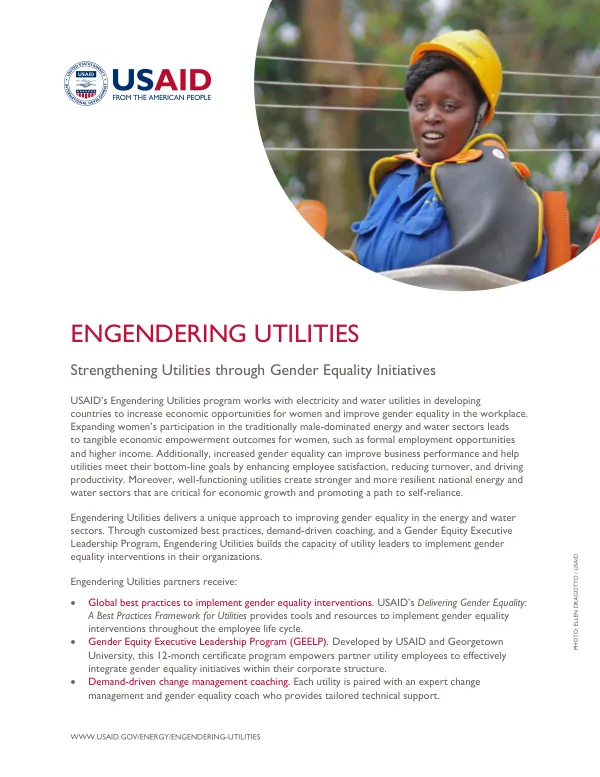
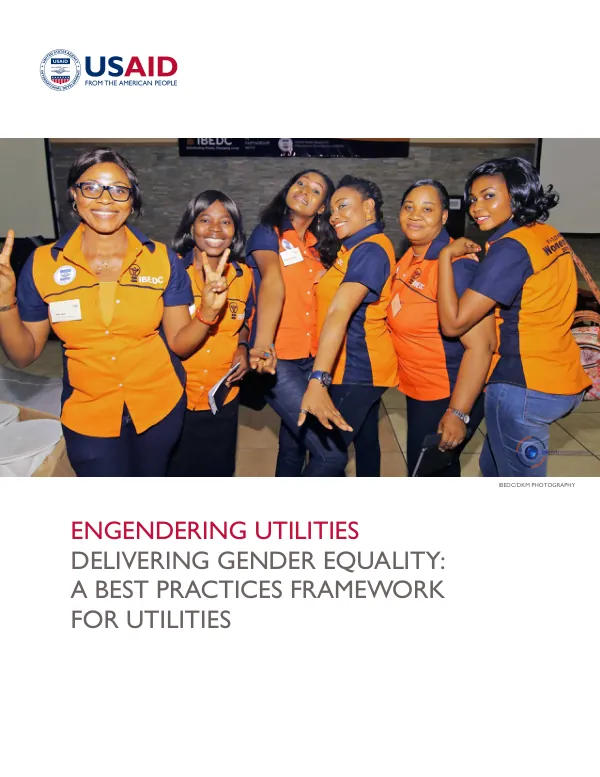
From attraction and talent outreach to separation and retirement, there are numerous opportunities to promote gender equality. The U.S. Agency for International Development (USAID) has developed a Best Practices Framework to guide utilities in implementing gender equity practices throughout the employee life cycle. The framework is divided into twelve categories, eight of which are part of the employee life cycle: attraction and talent outreach, recruiting and hiring, onboarding and training, performance management, compensation and benefits, talent and leadership development, retention and employee engagement, and succession planning and promotion. The other four categories represent organization enablers for gender equity: policies and grievance management, company performance and reporting, corporate communications and branding, and corporate culture and leadership. Within each category, multiple best practices are outlined that are derived from an extensive literature review of global resources and complemented by lessons learned from USAID's Engendering Utilities program. A description is provided for each best practice, as well as potential implementation challenges, examples of successful implementation, and tools, resources, and templates that provide additional information on each best practice. Attraction and talent outreach is a critical component of the employee life cycle, as it sets the stage for a diverse and inclusive workforce. Conducting outreach to educational institutions that leads to long-term attraction of both male and female job candidates is a best practice in this category. This can be achieved by identifying schools that have the potential to generate future employees, such as technical schools, universities, and higher-education institutions, and developing an outreach program with administration and faculty. However, technical schools have low numbers of women as students, and universities may also have fewer women in appropriate courses of study. To overcome these challenges, companies can increase awareness among the next generation workforce of potential jobs available upon graduation and what course of study is needed for graduates to get those jobs. This can be achieved through campaigns such as Women in Energy Work Inclusive Sourcing Wise, which aims to promote women in science, technology, and engineering. The target audience for this framework includes decision makers in utilities, including HR and operations professionals, as well as development practitioners, gender experts, and technical advisors throughout the energy sector. This framework can be used as a standalone guide for organizations looking to improve gender equality by identifying gaps in their current practices and taking concrete steps toward implementing sustainable change. The framework addresses issues related to both equity and equality, jointly referred to as "gender equality" to ensure consistency. Definitions for equality and equity can be found in the glossary in Annex II. The framework provides a comprehensive guide for utilities to promote gender equality and create a more inclusive and diverse workforce. The framework can be used as a standalone guide for organizations looking to improve gender equality by identifying gaps in their current practices and taking concrete steps toward implementing sustainable change. It is a valuable resource for decision makers in utilities, including HR and operations professionals, as well as development practitioners, gender experts, and technical advisors throughout the energy sector. The framework's best practices are designed to be adaptable to the unique needs and circumstances of each utility. They are based on a thorough review of global resources and lessons learned from USAID's Engendering Utilities program. The framework provides a comprehensive guide for utilities to promote gender equality and create a more inclusive and diverse workforce. The framework's best practices are designed to be implemented in a way that is consistent with the utility's existing policies and procedures. They are intended to be a starting point for utilities to begin implementing gender equity practices throughout the employee life cycle. The framework provides a comprehensive guide for utilities to promote gender equality and create a more
Related documents