USAID
Youth and Gender Analysis Toolkit
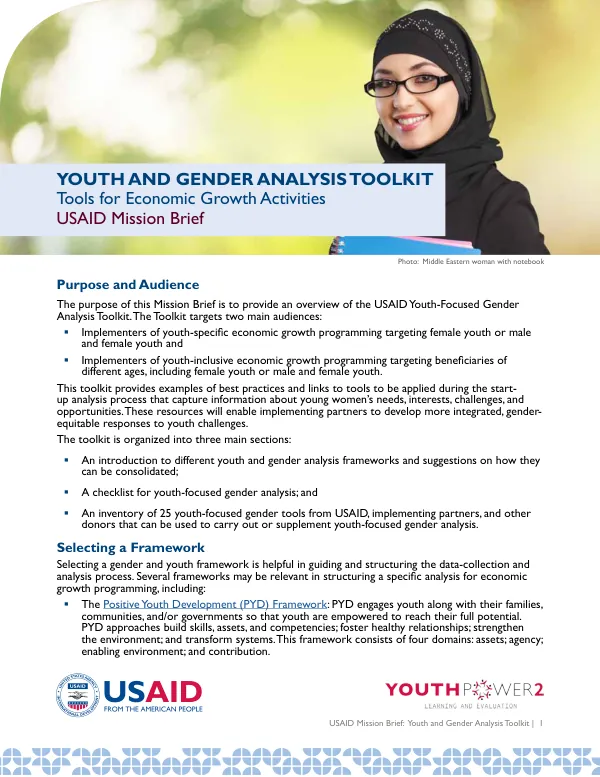
The Youth and Gender Analysis Toolkit is a resource designed to support the implementation of youth-focused economic growth programming that targets female youth or male and female youth.
2021 · 6 pages
Sign in to readA free account is required to download.
Abstract
The toolkit targets two main audiences: implementers of youth-specific economic growth programming and implementers of youth-inclusive economic growth programming. The purpose of the toolkit is to provide examples of best practices and links to tools that capture information about young women's needs, interests, challenges, and opportunities. The toolkit is organized into three main sections: an introduction to different youth and gender analysis frameworks, a checklist for youth-focused gender analysis, and an inventory of 25 youth-focused gender tools from USAID, implementing partners, and other donors. Selecting a framework is essential in guiding and structuring the data-collection and analysis process. Several frameworks may be relevant in structuring a specific analysis for economic growth programming, including the Positive Youth Development (PYD) Framework, ADS 205, and Mainstreaming Women's Economic Empowerment (WEE) in Market Systems Development (MSD). The checklist for youth-focused gender analysis provides guidance to teams conducting a youth-focused gender analysis during the start-up phase of their activities. The checklist includes items such as reviewing mission-level gender and youth analyses, identifying gaps in information, creating a plan to engage youth as researchers, and examining potential risks to participants. The toolkit also includes tools that can support youth- and/or gender-focused analysis for economic growth programming, such as the Youth Compass: A Strategic Guide to Strengthen Youth Activities and General Guidance for Youth- and/or Gender-Focused Analyses. The toolkit includes existing relevant tools that emerged through desk research, a survey of relevant stakeholders, and a validation workshop. Some of the recommended tools were designed specifically to target young women, while others may require some revision before being rolled out for young women specifically. The toolkit provides a list of "dos" and "do nots" to ensure tool revisions are capturing the intended data. The toolkit includes tools that provide general guidance for youth- and/or gender-focused analysis, sector-specific tools, and tools on additional topics such as soft skills, gender-based violence, and women in conflict zones. The objectives of the tools fall across several key categories, including start-up phase tools, technical area-specific tools, and tools that look at both younger and older women. Some examples of tools include the Youth Compass, General Guidance for Youth- and/or Gender-Focused Analyses, and Gender- and Youth-Sensitive Data Collection Tools to Support Decision-Making for Inclusive Sustainable Agricultural Intensification. The toolkit provides a comprehensive resource for implementers of youth-focused economic growth programming to support the development of more integrated, gender-equitable responses to youth challenges.