USAID
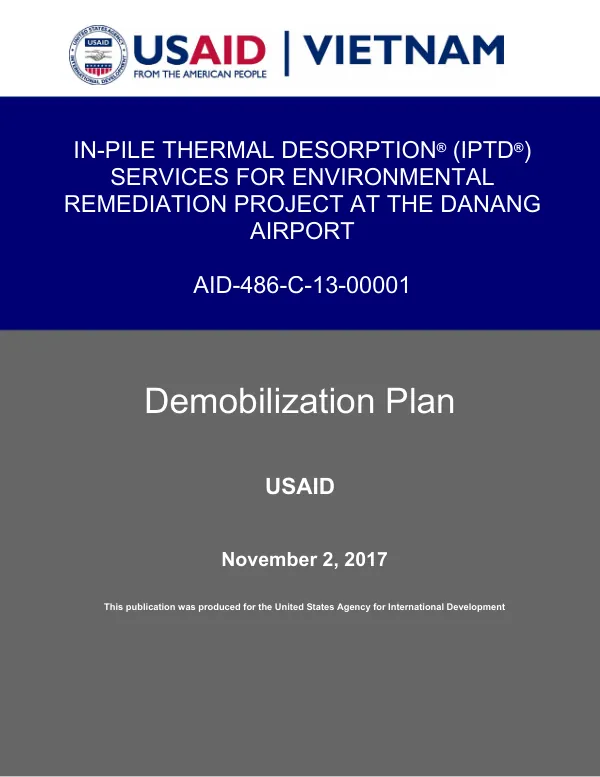
Demobilization Plan for Environmental Remediation at Da Nang Airport
Demobilization Plan for Environmental Remediation at Da Nang Airport The project area is located in Da Nang, Vietnam, and is part of the Da Nang Airport site.
2017 · 173 pages
Sign in to readA free account is required to download.
Abstract
The purpose of the demobilization plan is to ensure a safe and efficient transition of the site from the remediation activities to a post-remediation state. The general approach for demobilization involves several key components. Sampling methods and standards are outlined in Section 2.1, which includes dioxin acceptance limits for buy-back or donated equipment, dioxin acceptance limits for metallic and non-metallic scrap, and a tiered sampling approach. The identification of equipment and material as hazardous, contaminated, or potentially contaminated is also addressed in Section 2.2, which includes hazardous waste, potentially contaminated indirect waste, and potentially contaminated low-to-high impact waste. Decontamination methods are outlined in Section 2.3, which includes decontamination means and methods. The removal and dismantling sequencing is detailed in Section 3, which includes six phases: Phase 1 - Notice to Shut Down and Quench, Phase 2 - Post Quench, Phase 3 - IPTD Pile, Phase 4 - Quench and Scrubber, Phase 5 - Bit Treatment System, and Phase 6 - Liquid Treatment System. The disposition plan is outlined in Section 4.0, which includes the removal and disposal of equipment, materials, and materials contaminated with dioxin. The safety plan is outlined in Section 5.0, which includes personnel training and qualifications, emergency response and evacuation procedures, exposure potential and hazard by task/activity, personal protective equipment selection and use, and decontamination procedures. The documents and reporting requirements are outlined in Section 6.0, which includes documentation procedures, documentation of field activities, and reporting. The appendices include Disposition Plan, Foundry Documentation, Demobilization Schedule, and Emergency Evacuation Plan. Key acronyms and abbreviations used in the document include IPTD (In-Pile Thermal Desorption), CIEN (Civil Engineering Construction Corporation), CMC (Construction Management Corporation), CRZ (Contour Reduction Zone), DNAPL (Dense Non-Aqueous Phase Liquid), E&O (Errors and Omissions), FTIR (Fourier Transform Infrared Spectroscopy), GFH (Granular Ferric Hydroxide), GVN (Government of Vietnam), HASP (Health and Safety Plan), HDPE (High-Density Polyethylene), H&S (Health and Safety), IP (Internet Protocol), KOP (Knock Out Pots), KRG (Krüger), kW (Kilowatt), and LVTP (Liquid Vapor Treatment Plant). The project is funded by USAID (United States Agency for International Development) and is subject to the requirements outlined in Section C.4.3.2 of the IPTD contractor's implementation plan. The project is expected to be completed by November 2, 2017.
Related documents