USAID. MISSION TO HAITI
Democracy enhancement
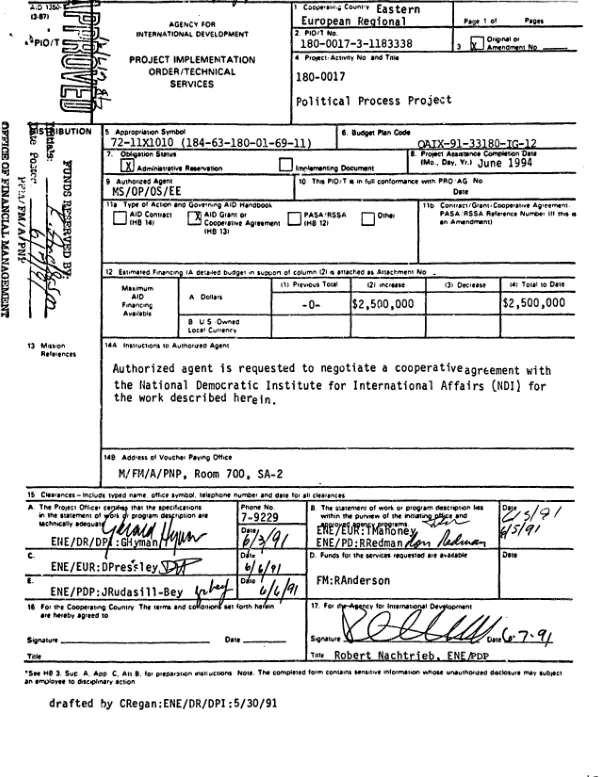
Project to strengthen Haitian institutions that can facilitate broad-based participation in democratic decisionmaking.
1991
Sign in to readA free account is required to download.
Abstract
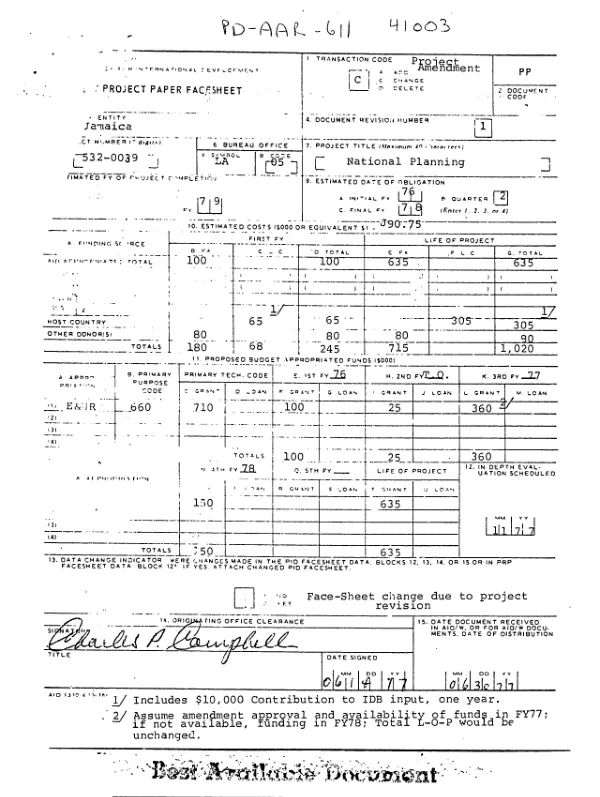
The project, to be implemented by various U.S. PVOs, will support the National Assembly, political parties, the Permanent Electoral Council (CEP), the independent sector, and local government. The project will fund seminars, study tours, short-term training, and information system equipment to strengthen the administrative efficiency of both houses of the National Assembly in three areas: (1) housekeeping (e.g., journal and calendar preparation, budgeting, procurement); (2) operations (e.g., bill drafting, research, information and management systems; and (3) systems maintenance (e.g., bill and committee flow analysis, goal setting, priority setting, etc.) This assistance will initially be provided by the Consortium for Legislative Development through a buy-in to 5980770. The National Endowment for Democracy (NED), operating through the National Democratic Institute (NDI) and the National Republican Institute (NRI), will provide support to Haitian political parties. NDI will provide TA in election analysis systems, arrange seminars on party building and legislative organization, and convene a conference on civil/military relations. NRI will open an office to serve as a resource and information center for all democratic parties in Haiti and will hold seminars and workshops on party building. All assistance will be provided on a non-partisan basis to all democratic parties in Haiti. Thirdly, the project will support the UN Development Program"s efforts to strengthen the CEP"s ability to conduct free elections in 1992 and beyond. To this end, USAID/H will conduct policy dialogue to encourage the Government to establish CEP as a permanent institution and will fund TA to help the UNDP to improve the CEP"s electoral registry. To promote democratic values and pluralism, the project will provide subgrants and TA to at least 10-15 independent organizations and 4-5 labor confederations, which together represent 200 separate labor unions. The subgrants, which will be awarded on a non-partisan basis, will support activities such include such activities as independent media development by the Association of Haitian Journalists; promotion of access to justice by the Haitian Center for Human Rights (CHADEL); debate on democratic issues through the Centre Petion Bolivar; and civic education through the Haitian Foundation for Aid to Women and Celebration 2004. Labor union activities will probably be managed by the American Institute for Free Labor Development (AIFLD), the other activities by a U.S. PVO umbrella management unit (UMU). The UMU will also provide support to Haiti"s newly elected local governments, primarily indirectly, e.g., through TA to the National Assembly in developing local government laws. Also, subgrants will be provided to the Haitian Institute for Research and Development and the Human Resources Development Center for training of at least 300 Administrative Councils of Communal Sections (CASECs) and 50 Municipal Councils in areas such as leadership, the constitution, and the structure and functions of the national government. Amendment of 3/20/95 updates the project, which (except for support to civil society) has been suspended since the 9/91 military coup; increases funding; and extends the PACD 4 years, to 5/99. The first component will strengthen all the originally targeted institutions of democratic governance (the Senate, the Chamber of Deputies, political parties, and local government), except the Electoral Council, which will continue to be assisted under the Election Support Project (5210254). The second component, civil society strengthening, will assist organizations (including labor) in conducting civic education and other activities at national and local levels to increase citizen participation, promote democratic values, and foster national dialogue and reconciliation. When the grants/agreements with the 6 currently participating PVOs expire in 6/95, the project will be implemented preferably through three contractors/grantees, one each for National Assembly, local government, and civil society. Existing grantees will be encouraged to continue to participate. (PD-ABL-101)
Related documents
Documents in this collection
 1992
1992USAID DEC
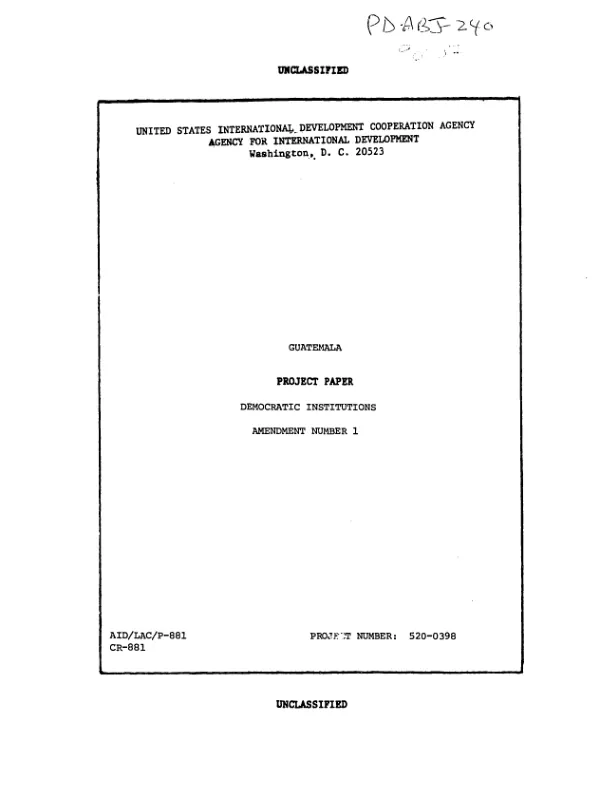
Democratic institutions : amendment no. 1
Open record![AID grant agreement no. 674-0301-G-SS-3061-00 to the National Democratic Institute for International Affairs (NDI) to provide impartial assistance and training to enable political organizations to educate voters and to participate in South Africa"s first democratic elections under the South Africa community outreach and leadership development [COLD] project](https://covers.devme.ai/gen/49808.webp) 1993
1993USAID DEC
![Democratic and civic institution development [: amendment no. 1]](https://covers.devme.ai/gen/13449.webp)