USAID. MISSION TO GUATEMALA
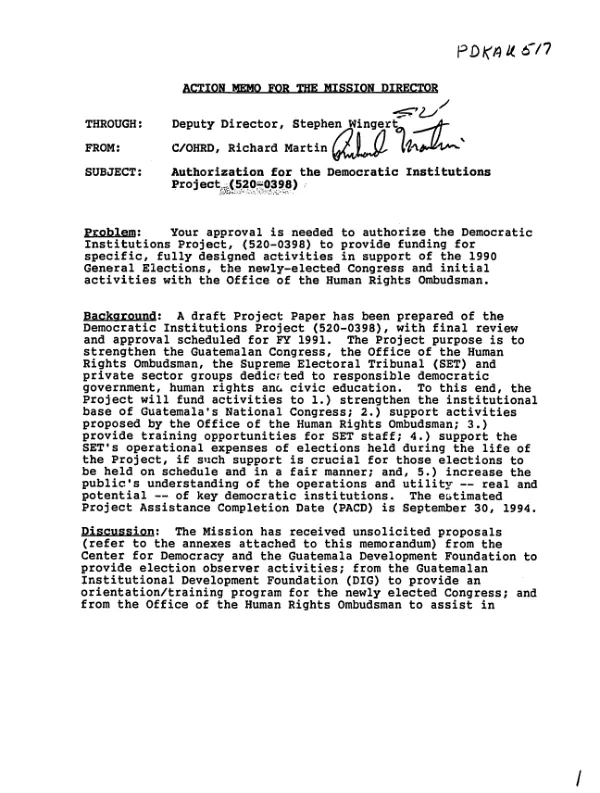
Authorization for the democratic institutions project (520-0398)
Project to strengthen democratic institutions in Guatemala.
1990
Sign in to readA free account is required to download.
Abstract
The project will assist the Guatemalan National Congress, the Office of the Human Rights Ombudsman (OHRO), the Supreme Electoral Tribunal, and private sector groups dedicated to democratic government, human rights, and civic education. Also funded are election observer activities for the 1990 General Elections. Amendment (Project Paper of 8/20/91, PD-ABD-691) reformulates the project, increases funding, and extends the PACD to 9/95. The project purpose is to institutionalize specific democratic processes in Guatemala by strengthening key democratic institutions (Congress, OHRO), and by supporting programs to improve public knowledge of and attitudes towards democracy. Five components are envisioned. Component one, strengthening of the National Congress"s legislative capacity, will include four types of activities: (1) improving of the legislative capabilities of Congressional Deputies (i.e., members of Congress) through training events, seminars, regional and U.S. visits, etc.; (2) upgrading the quality of Congressional staff support through training, hiring, and in-service training programs; (3) improving informational resources through upgrading of the Congressional library, integration of library and research services into Congress" MIS system, and establishment of linkages to organizations with legislative research and technical support capabilities (e.g., U.S. universities); and (4) a series of institutional development studies to review operating procedures and manuals, personnel policies, etc. The second component focuses on OHRO. To improve OHRO"s capabilities to investigate human rights violations, the project will help to establish a computerized violent crimes tracking system and to train personnel in investigative and reporting skills. The project will provide computer training (in word processing, system management, etc.) for 71 OHRO central office staff, as well as the training, equipment, etc., necessary to establish 12 new departmental offices (i.e., field offices) to augment 10 existing offices. To improve public knowledge and attitudes regarding human rights and democratic values and practices, the third component will support: (1) a wide range of OHRO human rights education efforts, from primary school programs, to nonformal programs for out-of-school populations, to multilingual radio campaigns and periodic human rights updates in the press; (2) feasibility studies concerning design of a follow-on USAID-financed civic education program; and (3) attendance by public and private leaders at an 8-month seminar, at the Center of Strategic Studies and National Stabilization (Centro ESTNA), regarding Guatemala"s political and socioeconomic development. Finally, two smaller components will establish (1) a system for monitoring indicators of democratic development and the impacts of this and other USAID-financed democratic development projects in Guatemala; and (2) a mechanism for financing small studies and pilot activities in topics such as decentralization, municipal development and local empowerment, and government financial accountability. Amendment of 9/22/92 extends PACD 2 years to 9/97, increases support to OHRO"s civic education activities, and decreases support to the National Congress. Civic education activities will include courses, seminars, and workshops in nonformal and grassroots education in support of the OHRO"s 5-year strategy and its Defense Offices; development of materials for Mayan speakers and the illiterate; production of other civic education materials; purchases of books and bookcases for departmental libraries; and development of radio programs in indigenous languages. Due to internal government communications problems, the formal education component will be eliminated. The National Congress suffers from lack of continuity and strong leadership; the project will continue many of its original activities under this component, but at a much reduced level. (PD-ABJ-240) Amendment of 5/18/94 increases funding for NGO nonformal civic education activities (which were originally authorized in a 1993 Action Memorandum). The new funds will be used to (1) support innovative, locally based civic, legal, and voter education activities; and (2) provide training and TA to indigenous NGOs. Emphasis will be placed on rural areas. A U.S. PVO will implement the new initiative under an umbrella grant. A portion of the new funds will be reserved for voter education for the 1995 general elections. (PD-ABJ-241)
![Human rights initiatives [(National Democratic Institute) : amendment]](https://covers.devme.ai/gen/67258.webp)
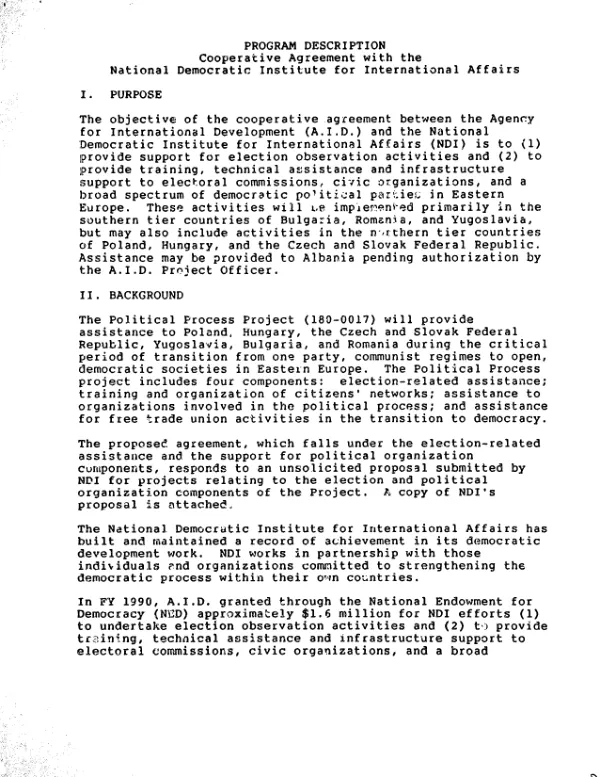
![AID grant agreement no. 674-0301-G-SS-3061-00 to the National Democratic Institute for International Affairs (NDI) to provide impartial assistance and training to enable political organizations to educate voters and to participate in South Africa"s first democratic elections under the South Africa community outreach and leadership development [COLD] project](https://covers.devme.ai/gen/49808.webp)