USAID DEC
Des opportunités pour améliorer le financement durable pour la planification familiale au Sénégal
Sign inHEALTH POLICY PLUS
Des opportunités pour améliorer le financement durable pour la planification familiale au Sénégal
The government of Senegal aims to become a middle-income country by 2035, with a focus on sectors and programs that impact the health sector, including family planning.
2019 · 16 pages
Sign in to readA free account is required to download.
Abstract
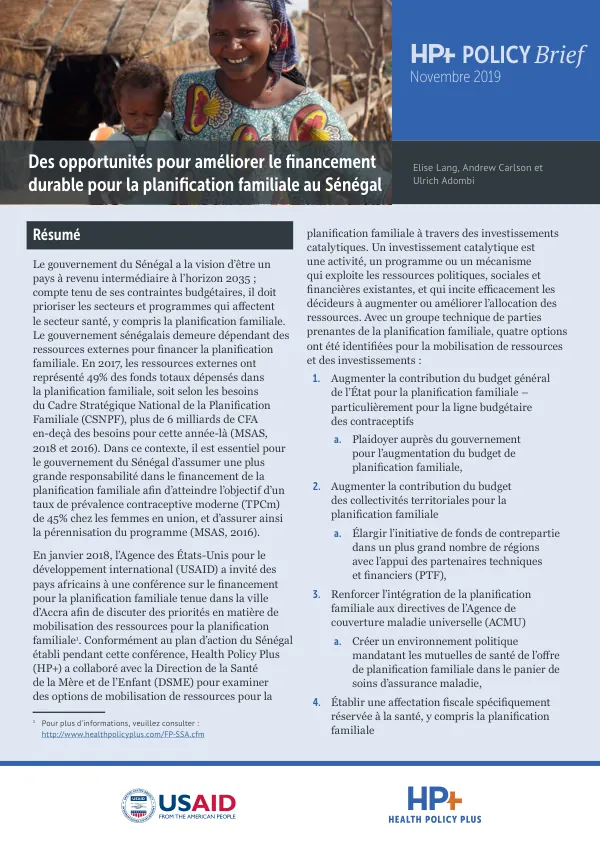
The government remains dependent on external resources to finance family planning, with external resources accounting for 49% of total funds spent on family planning in 2017. According to the National Strategic Framework for Family Planning (CSNPF), this represents a shortfall of over 6 billion CFA francs for that year. To achieve the goal of a 45% modern contraceptive prevalence rate (TPCm) among women in union and ensure the sustainability of the program, it is essential for the Senegalese government to assume greater responsibility in financing family planning. In January 2018, the United States Agency for International Development (USAID) invited African countries to a conference on family planning financing in Accra to discuss priorities for mobilizing resources for family planning. Following the conference, Health Policy Plus (HP+) collaborated with the Directorate of Mother and Child Health (DSME) to examine options for mobilizing resources for family planning through catalytic investments. A catalytic investment is an activity, program, or mechanism that leverages existing political, social, and financial resources and effectively encourages decision-makers to increase or improve resource allocation. With a technical working group of family planning stakeholders, four options were identified for mobilizing resources and investments: increasing the government's general budget contribution for family planning, particularly for the budget line for contraceptives; increasing the contribution of local government budgets for family planning; strengthening the integration of family planning into the Universal Health Insurance (ACMU) directives; and establishing a tax allocation specifically reserved for health, including family planning. The first option involves effective advocacy to increase the government's budget for family planning. The Senegalese civil society has a long experience in using best practices to mobilize resources, particularly at the subnational level. Despite the government's other priorities and the limited internal budget allocated to the Ministry of Health and Social Action (MSAS), policymakers are receptive and supportive of the family planning program. Advocacy does not require a high budget to be implemented, and given the expertise of Senegalese actors, this option is highly feasible. Analyses show that the return on investment can be over 300% in one year, and advocacy is a strategy that can be used systematically. The second option involves expanding the counterpart fund initiative. A second option for increasing domestic financing for family planning involves a project called The Challenge Initiative (TCI), funded by the Bill & Melinda Gates Foundation, which has developed an innovative approach to encouraging local governments to engage in family planning. The project supports mayors who take financial commitments for family planning, offering counterpart funds and technical assistance for the implementation of family planning programs. The project in Senegal has mobilized 31.4 million CFA francs in domestic funds for family planning. However, the cost of activities aimed at involving mayors, technical assistance itself, and managing counterpart funds is high compared to the funds mobilized by mayors. Therefore, expanding this approach is only possible with the support of partners, which makes it more difficult to implement and affects the financial return on investment. The third option involves strengthening the integration of family planning into health insurance. The complete integration of family planning into the implementation of health insurance in Senegal is a third option. The ACMU has developed a minimum package of activities and services (PMA) that should be covered by health insurance mutuals. However, there is no policy requiring health insurance mutuals or health facilities to cover these services for their insured. Health insurance mutuals have a lot of autonomy, and some health facilities limit the number of times insured individuals can use their insurance card to cover the cost of services over a given period. If the political environment is modified to make family planning a covered service, and if appropriate monitoring and accountability mechanisms are put in place, direct payment by users will be lower, allowing for better access to family planning. The fourth option involves analyzing the possibility of a tax allocation specifically reserved for health, including family planning. The last option examined here is that of a tax allocation specifically reserved for family planning. Several examples of the use of a specific (and reserved) tax allocation for financing a sector or program exist. In Nigeria, there is a tax allocation for health insurance, and in Guatemala for reproductive health, including family planning. Despite successful cases in other countries, examples of tax allocations reserved only for family planning are limited, and any type of allocation requires significant political support, particularly from the Ministry of Finance and Budget (MFB). Tax allocations restrict the government's ability to distribute already limited resources, and annual or administrative priorities can change. This option is the most difficult to implement but has the highest potential impact, as less than 1% of existing taxes could cover the total cost of contraceptives. According to its level, a tax allocation could ensure the stability and sustainability of the family planning program.