USAID DEC
Indirect Health Impacts of COVID-19 in Burkina Faso: Potential Impact of Declines in Utilization of Key Health Services
Sign inAVENIR HEALTH
Indirect Health Impacts of COVID-19 in Burkina Faso: Potential Impact of Declines in Utilization of Key Health Services
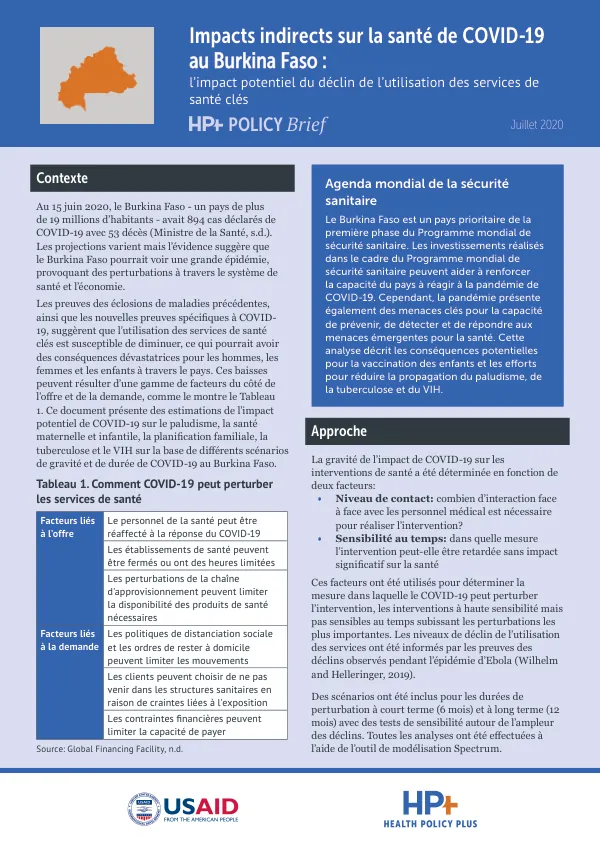
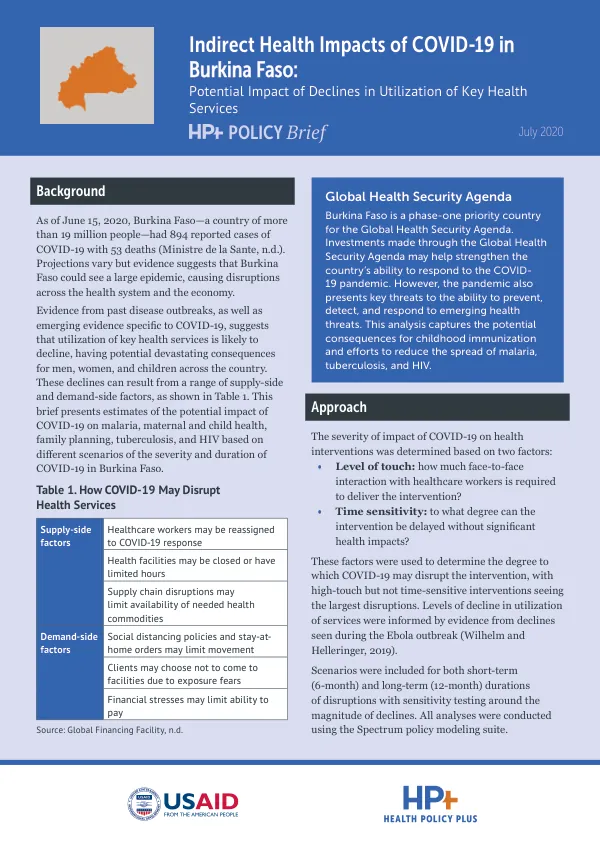
Burkina Faso, a country of over 19 million people, had 894 reported cases of COVID-19 with 53 deaths as of June 15, 2020.
2020 · 2 pages
Sign in to readA free account is required to download.
Abstract
Projections suggest a large epidemic, causing disruptions across the health system and the economy. Utilization of key health services is likely to decline due to supply-side and demand-side factors, including healthcare worker reassignment, health facility closures, and social distancing policies. The severity of COVID-19's impact on health interventions was determined by two factors: level of touch and time sensitivity. High-touch but not time-sensitive interventions, such as malaria case management, are expected to see the largest disruptions. Levels of decline in utilization of services were informed by evidence from declines seen during the Ebola outbreak. Scenarios were included for both short-term (6-month) and long-term (12-month) durations of disruptions with sensitivity testing around the magnitude of declines. The Global Health Security Agenda has identified Burkina Faso as a phase-one priority country. Investments made through this agenda may help strengthen the country's ability to respond to the COVID-19 pandemic. However, the pandemic also presents key threats to the ability to prevent, detect, and respond to emerging health threats. This analysis captures the potential consequences for childhood immunization and efforts to reduce the spread of malaria, tuberculosis, and HIV. Collectively across the five health areas, it is estimated that between 4,800 and 19,700 additional deaths could occur in 2020 alone as a result of disruptions from COVID-19. For some health areas, the impacts of even short disruptions may be seen for years to come. Malaria is expected to see an additional 2,800 to 9,300 deaths and 1 to 5 million more malaria disease episodes between 2020 and 2025. Family planning disruptions could lead to a 2 to 7 percentage point drop in the contraceptive prevalence rate, resulting in between 28,000 to 97,000 unintended pregnancies over the coming year. Maternal and child health reductions could contribute to between 7,000 and 27,000 additional maternal and child deaths between 2020 and 2025. Tuberculosis disruptions may lead to 700 to 2,600 additional deaths over 2020–2025, and progress toward "End TB" incidence targets may be set back four to five years. HIV interruptions could lead to an additional 170 to 500 deaths over 2020–2025. The impacts shown here are not inevitable. The country is already taking steps to ensure that essential services can be maintained and find ways to alter service delivery models. Recent guidance from the World Health Organization suggests ways countries can adjust, prioritize, and adapt services. Implementing these guidelines can help mitigate the potential devastating impacts of COVID-19 on other health outcomes.