USAID DEC
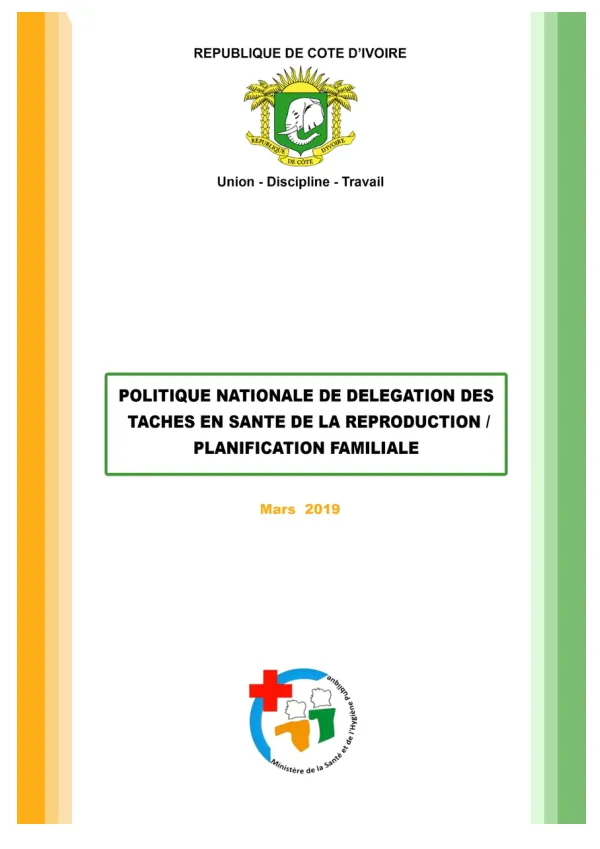
Politique Nationale de Délégation des Taches en Santé de la Reproduction/Planification Familiale
Sign inHEALTH POLICY PLUS
Politique Nationale de Délégation des Taches en Santé de la Reproduction/Planification Familiale
The National Policy on Delegation of Tasks in Reproductive Health/ Family Planning in Côte d'Ivoire was developed by the Ministry of Health and Hygiene with technical and financial support from the USAID through Health Policy Plus (HP+).
2019 · 44 pages
Sign in to readA free account is required to download.
Abstract
The policy aims to improve the delivery of reproductive health and family planning services by delegating tasks to lower-level health workers. The policy was developed in response to the country's high maternal, neonatal, infant, and adolescent mortality rates. The unequal distribution of qualified health personnel, particularly in rural and hard-to-reach areas, hinders access to basic healthcare services, hindering progress towards achieving the Sustainable Development Goals (SDGs). The policy is based on the World Health Organization's (WHO) recommendations on task delegation and the 18th Ordinary Session of the Ministers of Health of the Economic Community of West African States (ECOWAS), which adopted a resolution on promoting good practices in task delegation for the implementation of family health and reproductive programs. The policy has a clear vision, objectives, and interventions. The vision is to improve the delivery of reproductive health and family planning services by delegating tasks to lower-level health workers. The objectives are to improve the availability and accessibility of reproductive health and family planning services, reduce maternal and infant mortality rates, and improve the quality of care provided to women, children, and adolescents. The policy identifies several interventions that can be delegated to lower-level health workers, including the provision of family planning services, the management of reproductive tract infections, and the provision of post-abortion care. The policy also outlines the mechanisms for implementing the delegation of tasks, including the establishment of a task delegation committee and the development of a task delegation plan. The policy emphasizes the importance of monitoring and evaluating the implementation of the task delegation policy. It recommends the use of indicators to track progress and the establishment of a monitoring and evaluation system to ensure that the policy is implemented effectively. The policy concludes by emphasizing the need for all stakeholders to work together to implement the policy effectively. It highlights the importance of providing training and support to lower-level health workers and ensuring that they have the necessary resources and equipment to provide high-quality care. The policy is supported by several organizations, including the Agence Française de Développement (AFD), the Association Ivoirienne de Bien-Etre Familial (AIBEF), and the Health Policy Plus (HP+) program. The policy is also aligned with the country's national health policy and the WHO's recommendations on task delegation. The policy has several key stakeholders, including the Ministry of Health and Hygiene, the Direction de Coordination du Programme National de la Santé Mère et Enfant (DC-PNSME), the Direction Générale de la Santé (DGS), and the Direction Régionale de la Santé (DRS). The policy also involves several other stakeholders, including the Agence Nationale pour le Développement Rural (ANADER), the Aide-Soignant ou Auxiliaire de Santé (AS), and the Agent de Santé Communautaire (ASC). The policy has several key recommendations, including the establishment of a task delegation committee, the development of a task delegation plan, and the provision of training and support to lower-level health workers. The policy also recommends the use of indicators to track progress and the establishment of a monitoring and evaluation system to ensure that the policy is implemented effectively. Overall, the National Policy on Delegation of Tasks in Reproductive Health/ Family Planning in Côte d'Ivoire is a comprehensive policy that aims to improve the delivery of reproductive health and family planning services by delegating tasks to lower-level health workers. The policy is supported by several organizations and is aligned with the country's national health policy and the WHO's recommendations on task delegation.
Related documents