USAID DEC
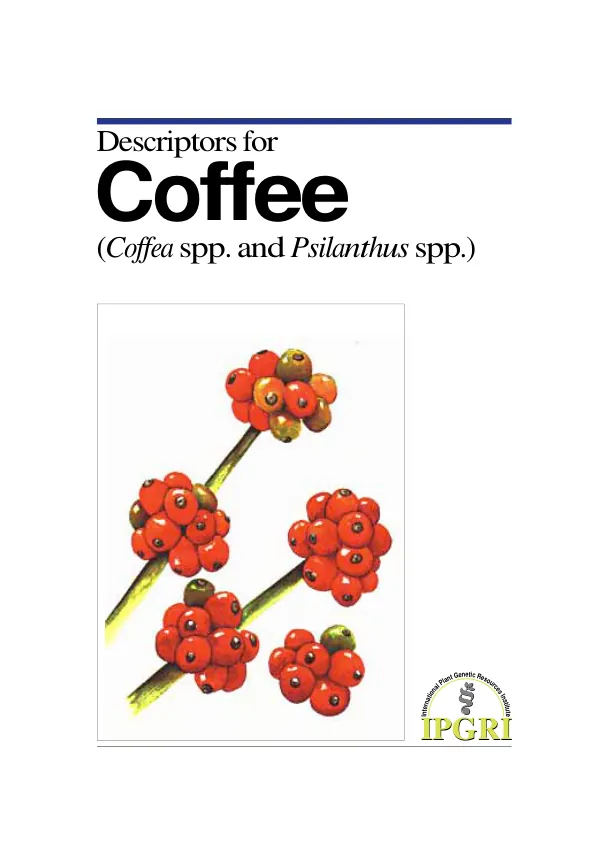
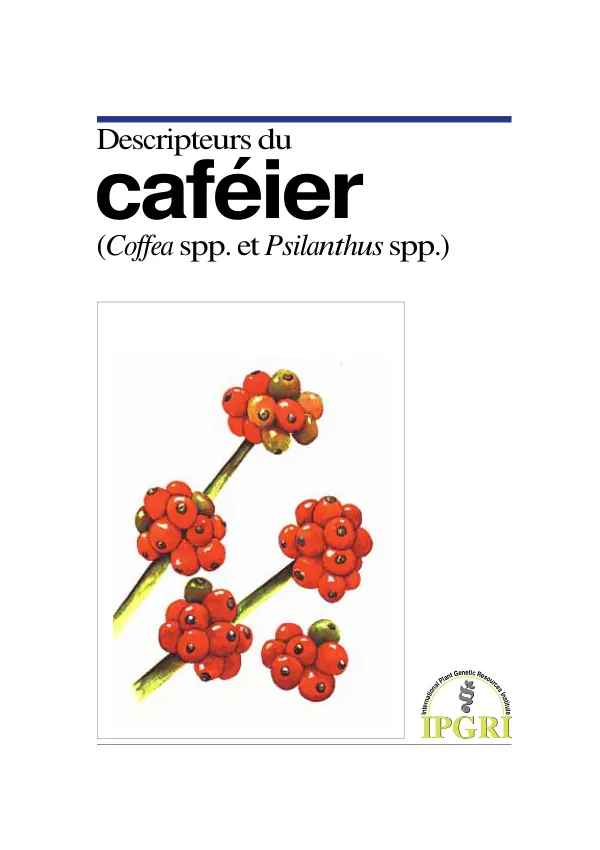
Descripteurs du caféier
The International Plant Genetic Resources Institute (IPGRI) has developed a set of descriptors for the coffee plant (Coffea spp.
39 pages
Sign in to readA free account is required to download.
Abstract
and Psilanthus spp.). These descriptors are used for the documentation of genetic resources and provide a standardized framework for the collection, characterization, and evaluation of coffee plant accessions. The descriptors are categorized into five main groups: passport, management, environment and site, characterization, and evaluation. The passport descriptors provide basic information used for the general management of accessions, including registration in a gene bank and other useful information for identification. They describe the parameters that should be observed during the original collection of the accession. The management descriptors provide the basis for the management of accessions in a collection and aid in their multiplication and regeneration. They include information on the type of material received, the size of the accession, and any additional notes. The environment and site descriptors describe the important parameters related to the environment and site for conducting characterization and evaluation trials. They can be useful for interpreting the results of these trials and include descriptors related to the site of collection of the genetic material. The characterization descriptors allow for easy and rapid differentiation between phenotypes. They have a strong heritability, can be easily observed with the naked eye, and are expressed in all environments. They can also include a limited number of additional characters considered desirable by a majority of users of the plant in question. The evaluation descriptors are a good number of descriptors of this category that are sensitive to environmental differences but are generally useful for improving cultivated plants. They can include characters related to yield, agronomic results, sensitivity to stress, and biochemical and cytological characters. These are normally the conservators of collections who are responsible for characterization, while evaluation is generally carried out elsewhere (if possible by a multidisciplinary team of researchers). The evaluation data must be returned to the collection that will manage a data file. The IPGRI uses the following standards for the coding of descriptor states: * The International System of Units (SI) should be used. Units to be applied are given in brackets after the name of the descriptor. * Normalized color charts, such as the Royal Horticultural Society Colour Chart, the Methuen Handbook of Colour, or the Munsell Color Chart for Plant Tissues, are strongly recommended for all non-gradual color characters (the chart used should be indicated in the section where it is used). * Several quantitative characters with continuous variation are noted on the basis of a scale of 1 to 9, where: 1 = Very weak 6 = Medium to strong 7 = Strong 3 = Weak 8 = Strong to very strong 4 = Weak to medium 9 = Very strong 5 = Medium * When a descriptor is recorded on a scale of 1 to 9, "0" will be attributed when (i) the character is not expressed; (ii) the descriptor is inapplicable. For example, "0" will be recorded if an accession does not have a central leaf lobe: Form of the central leaf lobe 3 = Toothed 5 = Elliptical 7 = Linear * The absence/presence of characters is recorded as in the following example: Absence/presence of a small terminal leaf 0 = Absent 1 (or +) = Present * Blanks are left for information not yet available. * For accessions that are generally not uniform for the descriptor (e.g., collected in mixture, genetic segregation), the mean and standard deviation are recorded if the descriptor has continuous variation. When the variation is discontinuous, several codes can be recorded in the order of frequency. Other known methods, such as that of Rana et al. (1991) or van Hintum (1993), which clearly establish a method for recording heterogeneous accessions, can also be used. * Dates should be expressed numerically in the format JJMMAAAA, where: JJ = 2 digits for the day MM = 2 digits for the month AAAA = 4 digits for the year. The passport descriptors for the coffee plant include: 1. Descriptors of the accession 1.1. Accession number This number is used as a unique identifier for accessions and is given by the curator when an accession is introduced into their collection. Once assigned, this number should never be reassigned to another accession in the collection. If an accession is lost, its number is not available for reuse. 1.2. Donor name The name of the institution or person who donated the germplasm considered. 1.3. Donor number The number assigned to an accession by the donor. 1.4. Other accession numbers Other identification numbers known in other collections for this accession, such as the USDA Plant Inventory number (this is not the Collection Number, see 2.3). Additional numbers can be added in 1.4.3, etc. 1.5. Scientific name 1.5.1. Gen
Related documents