USAID DEC
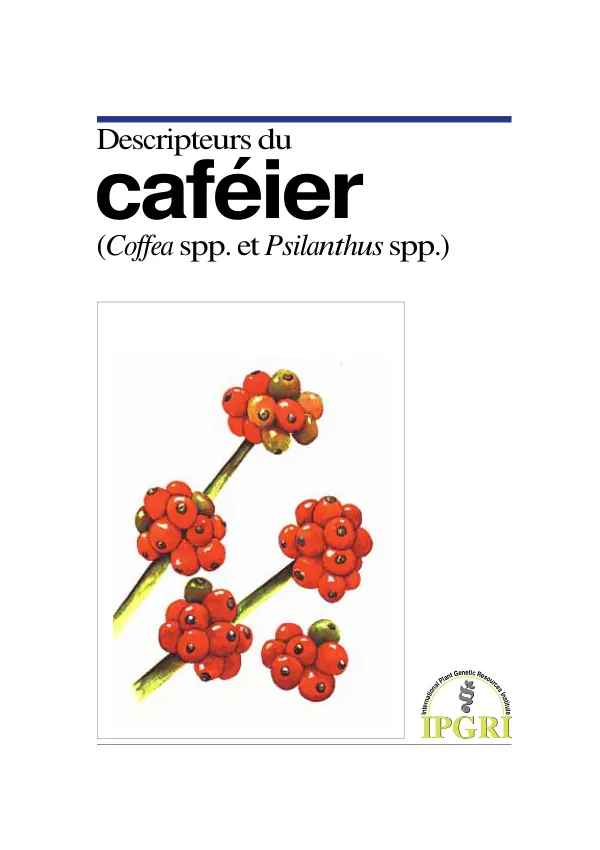
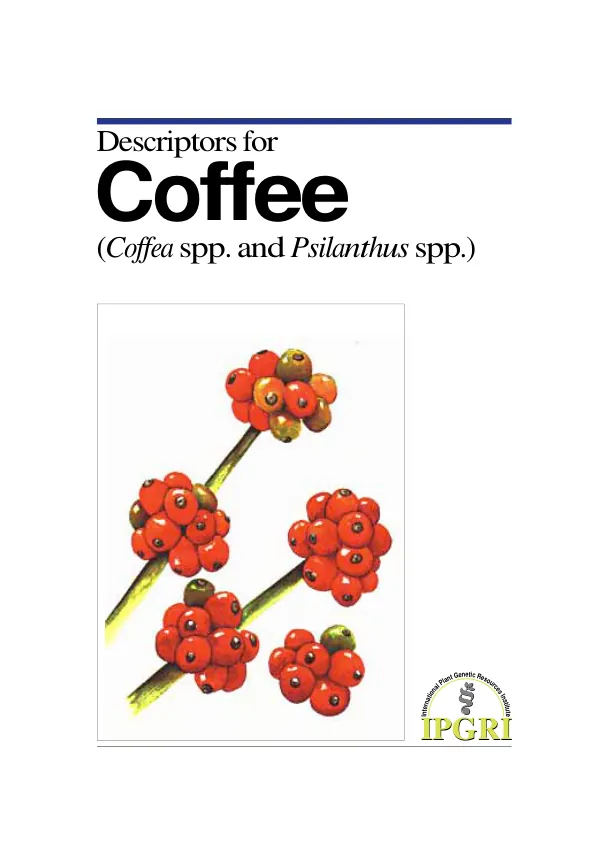
Descriptors for Coffee
Coffee is a crop that belongs to the genus Coffea and is native to tropical regions of Africa and Asia.
39 pages
Sign in to readA free account is required to download.
Abstract
The plant is a member of the Rubiaceae family and is cultivated for its seeds, which are used to produce coffee. There are over 100 species of coffee, with Coffea arabica and Coffea canephora being the most widely cultivated. Descriptors for coffee are used to provide information about the plant's characteristics, including its genetic makeup, physical appearance, and environmental requirements. These descriptors are essential for breeding and selection programs, as they enable researchers to identify and select plants with desirable traits. The descriptors are also used to document the plant's origin, collection site, and other relevant information. The International Plant Genetic Resources Institute (IPGRI) has developed a set of descriptors for coffee, which includes passport descriptors, management descriptors, environment and site descriptors, characterization descriptors, and evaluation descriptors. Passport descriptors provide basic information about the plant, including its accession number, donor name, and collecting date. Management descriptors provide information about the plant's management, including its type of material received and accession size. Environment and site descriptors describe the environmental and site-specific parameters that are important for the plant's growth and development. These descriptors include information about the plant's location, elevation, and climate. Characterization descriptors enable an easy and quick discrimination between phenotypes, and are generally highly heritable. Evaluation descriptors are used to assess the plant's performance in different environments and are susceptible to environmental differences. The IPGRI descriptors for coffee are based on internationally accepted norms for the scoring, coding, and recording of descriptor states. These norms include the use of the Système International d'Unités (SI system) and standard color charts for ungraded color characters. Quantitative characters are recorded on a 1-9 scale, where 1 represents very low and 9 represents very high. The passport descriptors for coffee include accession number, donor name, donor number, other numbers associated with the accession, scientific name, pedigree, cultivar name, acquisition date, type of material received, accession size, and notes. Collecting descriptors include collecting institute(s), site number, collecting number, collecting date of original sample, country of collecting, province/state, department/county, location of collecting site, latitude of collecting site, longitude of collecting site, elevation of collecting site, collecting source, collecting source environment, status of sample, type of sample, population size, population isolation, number of clonal material collected, type of stem cuttings collected, cropping system, and associated flora. The IPGRI descriptors for coffee are essential for breeding and selection programs, as they enable researchers to identify and select plants with desirable traits. The descriptors are also used to document the plant's origin, collection site, and other relevant information.
Related documents