USAID DEC
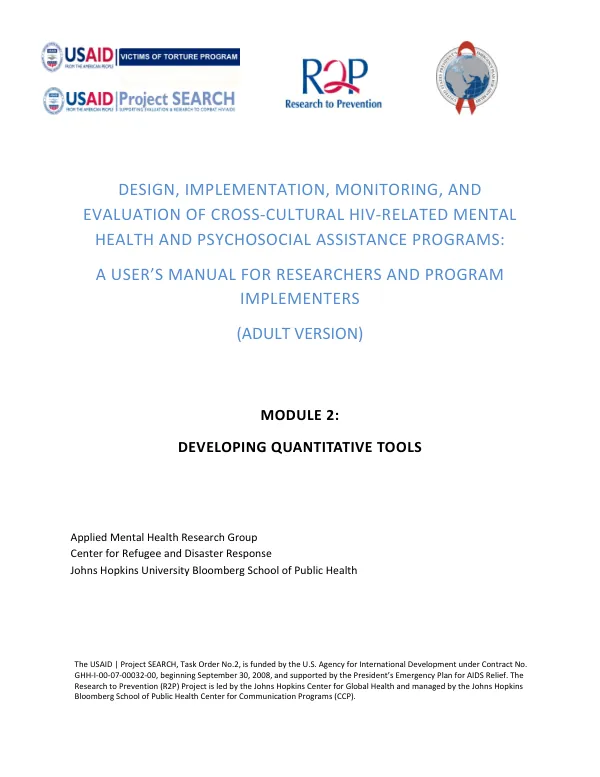
Design, Implementation, Monitoring, and Evaluation of Cross-Cultural HIV-Related Mental Health and Psychosocial Assistance Programs: A User’s Manual for Researchers and Program Implementers (Adult Version)
Sign inJOHNS HOPKINS UNIVERSITY BLOOMBERG SCHOOL OF PUBLIC HEALTH/INFO PROJECT
Design, Implementation, Monitoring, and Evaluation of Cross-Cultural HIV-Related Mental Health and Psychosocial Assistance Programs: A User’s Manual for Researchers and Program Implementers (Adult Version)
The DIME Model is a framework for designing, implementing, monitoring, and evaluating cross-cultural HIV-related mental health and psychosocial assistance programs.
73 pages
Sign in to readA free account is required to download.
Abstract
This manual is intended for researchers and program implementers working in adult populations. The DIME Model is a structured approach to developing quantitative tools for assessing mental health and psychosocial problems related to HIV. The model consists of four components: Design, Implementation, Monitoring, and Evaluation. The manual provides a detailed guide for each component, with a focus on developing quantitative tools for assessing mental health and psychosocial problems. The manual begins with an introduction to the DIME Model and its purpose. The layout of the manual is outlined, and the intended users are identified as researchers and program implementers working in adult populations. The manual then provides an overview of the DIME Model, including its components and the steps involved in each component. Module 2 of the manual focuses on developing quantitative tools for assessing mental health and psychosocial problems related to HIV. The module is divided into several sections, including the methodology, steps in the instrument development process, drafting the instrument, and testing the instrument. The methodology section outlines the steps involved in developing a quantitative tool for assessing mental health and psychosocial problems related to HIV. The steps include identifying the target population, developing a conceptual framework, and selecting a data collection method. The instrument development process section provides a detailed guide for developing a quantitative tool for assessing mental health and psychosocial problems related to HIV. The section includes information on drafting the instrument, including the demographic section, function section, mental health and psychosocial problem section, HIV-specific topics and issues section, instructions and response categories section, and translating the instrument. The pilot study section outlines the purpose and process of conducting a pilot study to test the instrument. The section includes information on selecting interviewees, conducting the interview, and analyzing the data. The reliability and validity testing section provides a detailed guide for testing the reliability and validity of the instrument. The section includes information on identifying interviewees, conducting the interview, and analyzing the data. The manual also includes several appendices, including an example field schedule, a resource list, a verbal consent form, and an example of a draft assessment instrument. The development of the DIME Model and this manual was supported by several grants from the Victims of Torture Program at USAID to The Applied Mental Health Research Group at Johns Hopkins University. The manual is an adaptation of the original manual, with specific reference to research on psychosocial and mental health problems related to HIV.
Related documents
Documents in this collection
USAID DEC
Design, Implementation, Monitoring, and Evaluation of Cross-Cultural HIV-Related Mental Health and Psychosocial Assistance Programs: A User’s Manual for Researchers and Program Implementers (Adult Version)
Open record
USAID DEC
Design, Implementation, Monitoring, and Evaluation of Cross-Cultural HIV-Related Mental Health and Psychosocial Assistance Programs: A User’s Manual for Researchers and Program Implementers (Adult Version)
Open record