USAID DEC
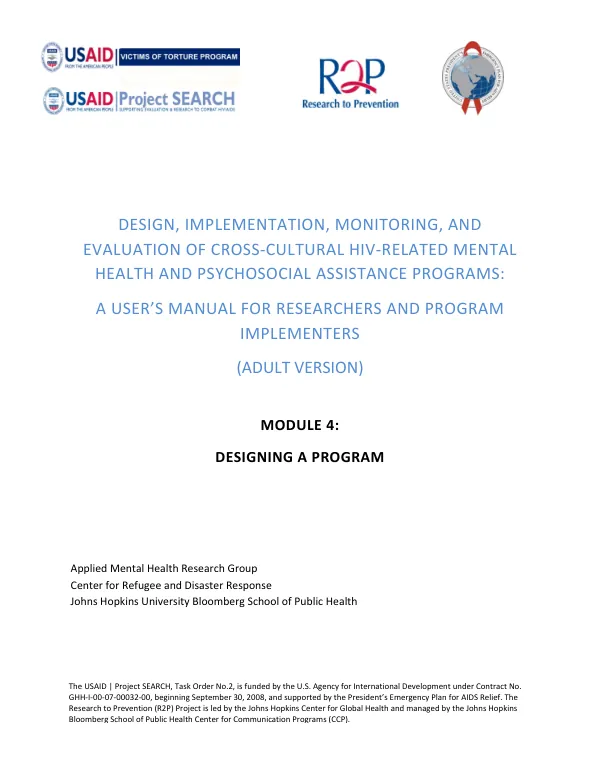
Design, Implementation, Monitoring, and Evaluation of Cross-Cultural HIV-Related Mental Health and Psychosocial Assistance Programs: A User’s Manual for Researchers and Program Implementers (Adult Version)
Sign inJOHNS HOPKINS UNIVERSITY BLOOMBERG SCHOOL OF PUBLIC HEALTH/INFO PROJECT
Design, Implementation, Monitoring, and Evaluation of Cross-Cultural HIV-Related Mental Health and Psychosocial Assistance Programs: A User’s Manual for Researchers and Program Implementers (Adult Version)
The DIME Manual USAID/Search adaptation: Module 4 is a user's manual for researchers and program implementers focused on designing, implementing, monitoring, and evaluating cross-cultural HIV-related mental health and psychosocial assistance programs.
48 pages
Sign in to readA free account is required to download.
Abstract
The manual is an adaptation of the original version, which was supported by the Victims of Torture Program (VOT) at USAID to The Applied Mental Health Research Group (AMHR) at Johns Hopkins University (JHU). This adaptation process was implemented by AMHR through Project SEARCH | USAID: Research to Prevention (R2P), funded by the United States Agency for International Development (USAID) through task order # GHH-I-00-07-00032. The manual is divided into several sections, including an introduction to the manual, layout of the manual, intended users, and the DIME model. Module 4 focuses on designing a program, which involves problem analysis, defining the vertical logic of the program, and defining the horizontal logic for the program. The problem analysis section includes developing a problem tree and an objectives tree diagram, while the vertical logic section involves defining the program goal, objectives, and intermediate results. The horizontal logic section includes deciding on objectively verifiable indicators for each logframe matrix and determining the means of verification for each indicator. The manual also includes a section on developing an activity network for each major activity, which involves listing tasks to be done to achieve each major activity and developing an activity network diagram for each list. Additionally, the manual includes a section on developing a Gantt chart for each intermediate result, which provides an overview of the Gantt chart and developing the Gantt chart. The manual is intended for researchers and program implementers working on cross-cultural HIV-related mental health and psychosocial assistance programs. It provides a comprehensive framework for designing, implementing, monitoring, and evaluating such programs, and is a valuable resource for anyone working in this field. The DIME model is a framework for designing, implementing, monitoring, and evaluating programs, which involves several key components, including problem analysis, vertical logic, and horizontal logic. The problem analysis section involves identifying the group to analyze the problem, resources needed, and analyzing the root causes of the problem. The vertical logic section involves defining the program goal, objectives, and intermediate results, while the horizontal logic section involves deciding on objectively verifiable indicators for each logframe matrix and determining the means of verification for each indicator. The manual includes several appendices, including examples of a problem tree, an objectives tree, a project strategy diagram, and a Gantt chart. These appendices provide additional guidance and support for implementing the DIME model and designing, implementing, monitoring, and evaluating cross-cultural HIV-related mental health and psychosocial assistance programs. The manual is a valuable resource for researchers and program implementers working on cross-cultural HIV-related mental health and psychosocial assistance programs, and provides a comprehensive framework for designing, implementing, monitoring, and evaluating such programs.
Related documents
Documents in this collection
USAID DEC
Design, Implementation, Monitoring, and Evaluation of Cross-Cultural HIV-Related Mental Health and Psychosocial Assistance Programs: A User’s Manual for Researchers and Program Implementers (Adult Version)
Open record
USAID DEC