USAID DEC
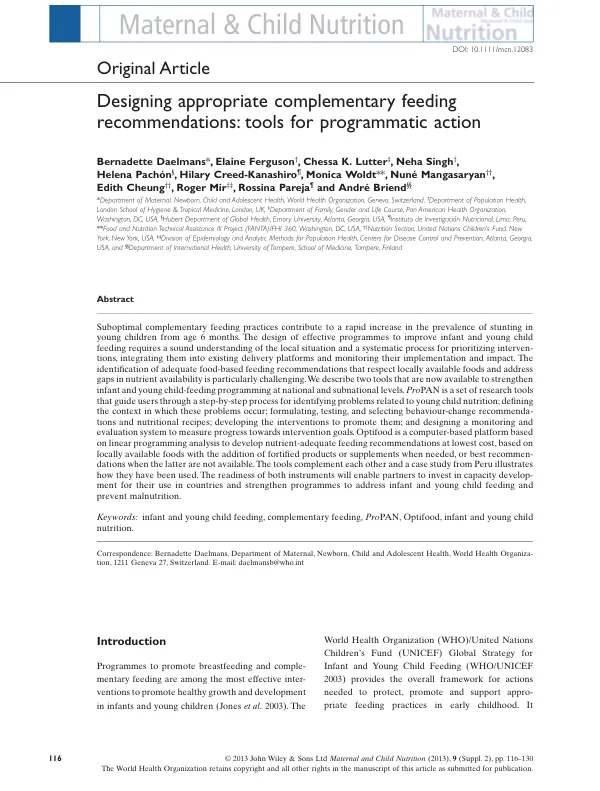
Designing appropriate complementary feeding recommendations: tools for programmatic action
Sign inFHI 360
Designing appropriate complementary feeding recommendations: tools for programmatic action
The World Health Organization (WHO) has identified suboptimal complementary feeding practices as a major contributor to the rapid increase in the prevalence of stunting in young children from age 6 months.
2013 · 15 pages
Sign in to readA free account is required to download.
Abstract
The design of effective programs to improve infant and young child feeding requires a sound understanding of the local situation and a systematic process for prioritizing interventions, integrating them into existing delivery platforms, and monitoring their implementation and impact. The identification of adequate food-based feeding recommendations that respect locally available foods and address gaps in nutrient availability is particularly challenging. To address this challenge, the WHO has developed two tools to strengthen infant and young child-feeding programming at national and subnational levels. ProPAN is a set of research tools that guide users through a step-by-step process for identifying problems related to young child nutrition, defining the context in which these problems occur, formulating, testing, and selecting behavior-change recommendations and nutritional recipes, developing the interventions to promote them, and designing a monitoring and evaluation system to measure progress towards intervention goals. Optifood is a computer-based platform based on linear programming analysis to develop nutrient-adequate feeding recommendations at the lowest cost, based on locally available foods with the addition of fortified products or supplements when needed, or best recommendations when the latter are not available. The tools complement each other and a case study from Peru illustrates how they have been used. The readiness of both instruments will enable partners to invest in capacity development for their use in countries and strengthen programs to address infant and young child feeding and prevent malnutrition. The WHO/United Nations Children's Fund (UNICEF) Global Strategy for Infant and Young Child Feeding provides the overall framework for actions needed to protect, promote, and support appropriate feeding practices in early childhood. The strategy recommends early initiation of breastfeeding, exclusive breastfeeding for 6 months, and the introduction of adequate complementary foods at 6 months with continued breastfeeding for 2 years or beyond. The time of complementary feeding, typically between 6 and 23 months of age, is nutritionally the most vulnerable and in developing countries coincides with a rapid acceleration in the incidence of stunting, especially among children 6-12 months. Complementary foods may be dilute, lacking diversity, not given frequently enough, given in too little amounts, or prepared and given with insufficient attention to hygiene and food safety. The Pan American Health Organization/WHO Guiding Principles for Complementary Feeding of the Breastfed Child propose 10 guiding principles for complementary feeding. Similar guiding principles are available for feeding of non-breastfed children. Recognizing the challenge to provide a nutritionally adequate diet for young children in resource-poor settings, national strategies should maximize the utilization of locally produced foods in any given setting, and consider the promotion of additional products only if they can fill a critical gap in nutrients in an acceptable, feasible, affordable, sustainable, and safe way. ProPAN and Optifood tools are now available to enhance the assessment, planning, monitoring, and evaluation of infant and young child-feeding programs. When used alone or in synergy, these tools provide guidance for the development of feeding recommendations, prioritization of interventions, design of key messages and communication strategy, policy and advocacy, monitoring, and evaluation.