UNIVERSITY OF MINNESOTA
Determinants of fertility, a micro economic model of choice
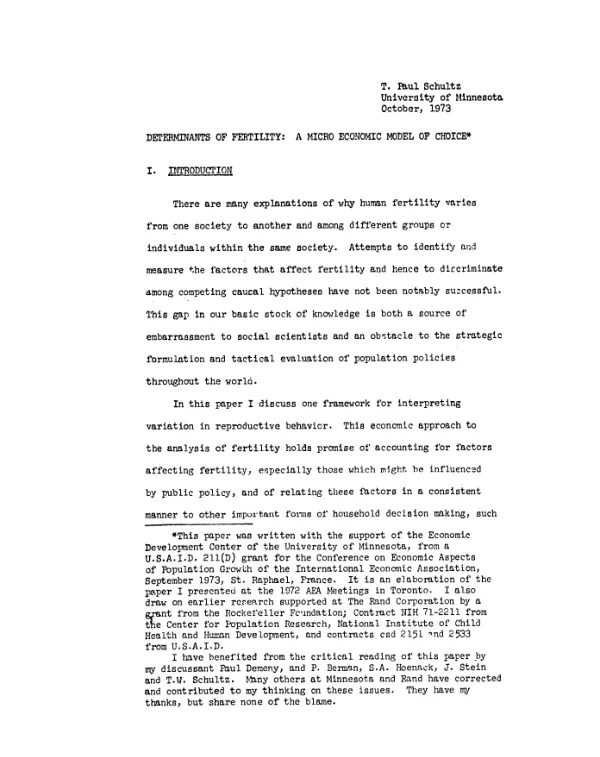
In this paper the author discusses one framework for interpreting variation in reproduction behavior.
Schultz, T. P. · 1970
Sign in to readA free account is required to download.
Abstract
This economic approach to the analysis of fertility holds promise of accounting for factors affecting fertility, especially those which might be influenced by public policy, and of relating these factors in a consistent manner to other important forms of household decision making, such as labor force participation, marriage and savings. Unlike many other areas of household nonmarket choice, the number of children a couple has is, of course, readily measured. Recent progress in the extension of economic analysis to the study of fertility has clarified many issues, but the field remains in a state of flux. For the economic approach to yield empirically refutable propositions it is necessary to impose upon it a number of specific assumptions. At this time, however, it is unclear which set of assumptions least impairs the model"s realism. The objective is to restate the central theoretical elements of this approach to the determinants of fertility, explore briefly as yet unsolved problems with this schema, and speculate on its usefulness for the choice and evaluation of policy.
Connected topics
Related documents